Your heart rate spikes. Your thoughts scatter. The meeting starts in two minutes. If you've ever felt a wave of nervous energy right before a work call or presentation, you're not alone — and you don't need 20 minutes of meditation to fix it. This guide covers how to calm your nerves before a meeting using fast, science-backed techniques you can use at your desk, in a hallway, or on a Zoom waiting screen. Most work in 60 seconds or less.
Why Do You Get Nervous Before Meetings?
Right before you speak, your autonomic nervous system shifts into sympathetic activation — commonly called fight-or-flight mode. Your brain detects a perceived social threat (being evaluated, needing to perform) and prioritizes speed over clarity.
That's why meeting anxiety can look like:
-
Shorter, shallower breathing — your body is preparing for physical action, not conversation
-
Shoulder and jaw tension — muscles tighten as part of the stress response
-
Racing or scattered thoughts — your prefrontal cortex (the reasoning part) takes a backseat to your amygdala (the alarm system)
-
Trouble finding your first sentence — working memory narrows under stress
-
Increased heart rate — adrenaline release causes your pulse to speed up
Here's the key insight: you don't need to calm down completely. You just need to shift your nervous system enough to think and speak clearly. That's a much lower bar — and it's achievable in under a minute.
7 Ways to Calm Your Nerves Before a Meeting
These techniques are built for real-world use. No quiet room required. No 10-minute setup. Just fast switches you can use in the minutes before any call, presentation, or meeting.
1. Extend Your Exhale (The Fastest Technique)
This is the single most effective way to calm anxiety before a work meeting quickly.
How to do it:
-
Inhale normally through your nose (3–4 seconds)
-
Exhale slowly through your mouth (6–8 seconds)
-
Repeat for 5 breath cycles
Why it works: Longer exhales activate your vagus nerve, which triggers your parasympathetic nervous system — the "rest and digest" counterpart to fight-or-flight. Research from Stanford University's Huberman Lab has shown that this "physiological sigh" pattern is one of the fastest real-time stress interventions available.
You can do this on a Zoom waiting screen, at your desk, or walking to a conference room. Nobody will notice.
2. Drop Your Shoulders (One Physical Reset)
Tension accumulates in your shoulders and neck without you realizing it — especially when you're nervous before meetings.
How to do it:
-
Lift your shoulders toward your ears
-
Roll them back
-
Release and let them drop completely
-
Do this once — that's all you need
Why it works: This breaks the muscle tension loop that feeds back into your brain's stress signals. When your body relaxes, your brain gets the signal that the threat level is lower than it assumed.
3. Narrow Your Focus to One Task
Scattered thoughts are a hallmark of pre-meeting jitters. The fix isn't to think more clearly — it's to think about less.
How to do it:
-
Tell yourself: "Just say the first sentence clearly."
-
Don't try to rehearse the whole meeting in your head
-
Pick one clear opening line and anchor to that
Why it works: Anxiety widens your attentional scope (you're scanning for threats). Deliberately narrowing your focus to one small, achievable task reverses that pattern. Clarity returns when the pressure narrows.
4. Use the 5-4-3-2-1 Grounding Technique
This is a well-known method for calming nerves before a meeting when your thoughts are spiraling.
How to do it:
-
Notice 5 things you can see
-
Notice 4 things you can touch
-
Notice 3 things you can hear
-
Notice 2 things you can smell
-
Notice 1 thing you can taste
Why it works: Sensory grounding pulls your attention out of future-focused worry ("What if I mess up?") and into present-moment awareness. It interrupts the anxiety loop by giving your brain concrete data to process instead of hypothetical scenarios.
5. Reframe Nerves as Readiness
Research from Harvard Business School found that people who reframed anxiety as excitement performed significantly better in stressful tasks than those who tried to suppress their nervousness.
How to do it:
-
Instead of thinking "I'm so nervous", tell yourself "I'm ready for this" or "This energy means I care"
-
Don't fight the physical sensations — reinterpret them
Why it works: Nervousness and excitement produce nearly identical physical responses (elevated heart rate, adrenaline, heightened alertness). The difference is the label your brain assigns. Changing the label changes the experience.
6. Do a 30-Second Body Scan
If you're not sure where your tension is hiding, a quick body scan helps you find and release it.
How to do it:
-
Start at the top of your head
-
Mentally scan down: forehead, jaw, neck, shoulders, chest, stomach, hands
-
Wherever you notice tightness, consciously relax that area
-
Takes about 30 seconds
Why it works: Most people carry stress in 1–2 specific areas without realizing it. A body scan makes unconscious tension conscious — and conscious tension is much easier to release.
7. Arrive (or Log On) 2 Minutes Early
This one is logistical, not psychological — but it makes everything else on this list possible.
How to do it:
-
Join the Zoom call or walk into the room 2 minutes before the meeting starts
-
Use those 2 minutes for any technique above
-
Avoid scrolling your phone or checking email in those final minutes
Why it works: The biggest reason people feel nervous before meetings is that they rush in with no buffer. Two minutes of intentional stillness is enough time to run through an exhale cycle, drop your shoulders, and pick your opening sentence.
A 60-Second Pre-Meeting Reset (Quick Reference)
Need the shortest version? Here's a repeatable routine you can use before any meeting:
| Step | Action | Time |
| 1 | Extended exhale — 5 slow breath cycles | 30 sec |
| 2 | Shoulder drop — lift, roll, release once | 5 sec |
| 3 | Narrow your focus — "Just say the first sentence clearly" | 5 sec |
| 4 | Arrive early — use the buffer, don't fill it with email | 2 min before |
Most people feel noticeably steadier within a minute of starting this sequence.
Why Most "Calm Down" Advice Doesn't Work Before Meetings
Most anxiety management advice is designed for after the stressful event or for long-term regulation:
-
End-of-day journaling
-
Long walks or exercise
-
Supplements taken hours beforehand
-
20-minute guided meditations
-
Therapy techniques practiced over weeks
Those tools are valuable — but they don't solve the immediate problem. Meeting anxiety happens in a 2–5 minute window right before you need to perform. You need tools that match that timeline.
That's why the best approach for how to not be nervous in meetings is building small, repeatable pre-meeting switches:
-
A breath pattern you always use
-
A posture reset that takes 5 seconds
-
A cue phrase like "first sentence only"
-
A habit of joining 2 minutes early
These aren't daily rituals. They're moment-specific tools for the window before you speak.
When Meeting Anxiety Is More Than Just Nerves
Normal pre-meeting nervousness is common — surveys suggest over 70% of professionals experience it regularly.
But if your meeting anxiety is:
-
Causing you to avoid or cancel meetings entirely
-
Creating physical symptoms like nausea, dizziness, or panic
-
Lasting well beyond the meeting itself
-
Getting worse over time rather than better
-
Significantly impacting your work performance
...it may be worth speaking with a mental health professional. These could be signs of social anxiety disorder or generalized anxiety, which respond well to professional treatment (including CBT and, in some cases, medication).
The techniques in this article are designed for normal situational nervousness — not as a substitute for professional care.
Frequently Asked Questions
How do I calm my nerves before a meeting quickly?
The fastest method is extended exhale breathing: inhale for 3–4 seconds, exhale for 6–8 seconds, and repeat for 5 cycles. This activates your vagus nerve and shifts your nervous system out of fight-or-flight mode in under 60 seconds. Pair it with a single shoulder drop and narrowing your focus to your first sentence.
Why do I get so nervous before meetings?
Pre-meeting nervousness is a normal stress response. Your brain detects a social-evaluative threat (being watched, needing to perform) and activates your sympathetic nervous system. This causes shallow breathing, muscle tension, racing thoughts, and elevated heart rate. Over 70% of professionals report experiencing this regularly.
How do I stop anxiety before a Zoom meeting?
Join the Zoom call 2 minutes early and use the waiting time for an extended exhale cycle (5 breaths with longer exhales). Drop your shoulders once. Tell yourself your only goal is to say the first sentence clearly. Avoid checking email or scrolling in those final minutes — stillness helps more than distraction.
Is it normal to feel nervous before every meeting?
Yes. Recurring meeting nervousness is extremely common, especially for meetings that involve presenting, being evaluated, or speaking to senior leadership. It doesn't mean something is wrong with you. However, if the anxiety causes you to avoid meetings entirely or creates severe physical symptoms, consider speaking with a professional.
What helps with pre-meeting jitters at work?
Build a repeatable 60-second routine: extended exhale breathing (30 seconds), one shoulder reset (5 seconds), and narrowing your focus to one clear opening line. Arrive or log on 2 minutes early so you have a buffer to run through this sequence. Consistency makes the routine more effective over time.
Can breathing exercises really help with meeting anxiety?
Yes — this is one of the most well-supported interventions in stress research. Extended exhale breathing activates the parasympathetic nervous system through the vagus nerve, directly counteracting the fight-or-flight response. Studies from Stanford and other institutions have shown measurable reductions in cortisol and heart rate from just 5 breath cycles with elongated exhales.
Key Takeaway
Before your next meeting:
Longer exhale. Shoulders drop. Say the first sentence clearly.
You don't need to feel perfectly calm. You just need to feel clear enough to speak. That's the only bar that matters — and it's one you can hit in 60 seconds.
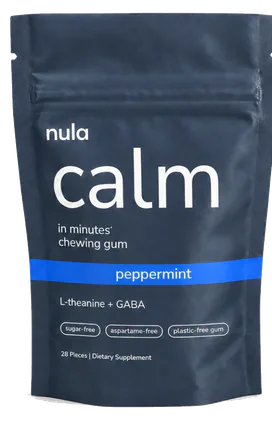
Nula Calm Gum
100 mg L-theanine + 50 mg GABA in every piece. caffeine-free. chew 1–2 pieces for at least three minutes.
shop calm