The plane is boarding. You find your seat, buckle in, and the cabin door closes. Suddenly the space feels smaller. The engines rumble underneath you and the air feels thicker. You notice the rows of strangers packed in on both sides, the sealed exits, the fact that in a few minutes this metal tube will be 35,000 feet above the ground — and you can't get off.
Then turbulence hits. The plane drops, your stomach rises, and your hands lock onto the armrests like they might save you. Your chest tightens. Your thoughts race. You want to stand up, get out, do something — but there's nowhere to go.
This is flight anxiety, and if you've felt it, you already know: it's not subtle. It's visceral, physical, and completely consuming. But it can be interrupted. This guide covers fast, practical techniques you can use right in your seat — before takeoff, during turbulence, or mid-flight — to bring your nervous system back under control.
Why Flying Triggers Your Stress Response
Flight anxiety isn't a character flaw or a lack of logic. It's a nervous system response — and it makes sense when you look at what flying actually asks your body to tolerate.
Your autonomic nervous system is constantly scanning your environment for threats. When you board a plane, it detects a combination of triggers that are almost perfectly designed to activate sympathetic fight-or-flight mode:
-
Enclosed space with no option to leave
-
Complete lack of control over the vehicle, the route, or the altitude
-
Altitude and pressure changes that feel physically unfamiliar
-
Turbulence that mimics falling or instability
-
Noise and vibration from the engines that your body reads as danger signals
That combination creates a perfect storm for stress activation. Here's what it feels like in the body:
-
Heart racing or pounding — adrenaline flooding your system
-
Shallow, rapid breathing — your body preparing for physical action
-
Sweaty palms — part of the sympathetic stress response
-
Catastrophic thinking — "What if the engine fails? What if we drop?"
-
Muscle tension — gripping armrests, clenching jaw, tight shoulders
-
Nausea or stomach discomfort — blood redirecting away from digestion
Here's the key insight: your nervous system is reacting to perceived danger, not actual danger. The threat detection system in your brain doesn't distinguish between real risk and the feeling of risk. Statistically, flying is extraordinarily safe — but your body doesn't run on statistics. It runs on signals.
The good news: you don't need to convince yourself that flying is safe. You just need to shift your nervous system enough to ride comfortably. That's a much lower bar, and it's reachable from your seat.
6 Ways to Calm Flight Anxiety Fast
These techniques are designed specifically for the airplane environment. No quiet room. No standing up. No special equipment. Everything works from your seat, with the seatbelt sign on.
1. Extended Exhale Breathing
This is the single fastest way to interrupt flight anxiety in real time. It works before takeoff, during turbulence, or at any point mid-flight.
How to do it:
-
Inhale slowly through your nose for 4 seconds
-
Exhale through your mouth for 6-8 seconds
-
Focus on making the exhale longer than the inhale
-
Repeat for 5 cycles (about 60 seconds)
Why it works: Longer exhales activate your vagus nerve, which triggers the parasympathetic nervous system — your body's built-in brake pedal for stress. Research from Stanford's Huberman Lab has identified this "physiological sigh" pattern as one of the fastest real-time interventions for calming the fight-or-flight response. You can do this with your eyes open, in a middle seat, with turbulence happening around you. Nobody will notice.
2. The Ice or Cold Water Trick
Cold activates the dive reflex, a mammalian response that immediately slows your heart rate and pulls your nervous system toward calm.
How to do it:
-
Ask a flight attendant for a cup of ice or cold water
-
Hold the cup against your wrists or the sides of your neck
-
If you have ice, press a piece between your palms for 15-20 seconds
-
Alternatively, press a cold water bottle to your forehead or cheeks
Why it works: Cold exposure triggers the vagus nerve through a different pathway than breathing — it's a physiological override. Your body automatically lowers heart rate and redirects blood flow when it detects cold on the skin. This is why splashing cold water on your face works for panic — and why a cup of ice on a plane can be surprisingly effective. It gives you something physical to focus on when breathing alone isn't enough.
3. 5-4-3-2-1 Grounding
When your thoughts start spiraling — catastrophic "what if" thinking, imagining worst-case scenarios — sensory grounding pulls you back into the present moment.
How to do it:
-
Name 5 things you can see (seat pocket, window, overhead bin, your hands, the person's jacket in front of you)
-
Name 4 things you can touch (armrest texture, seatbelt fabric, your own knees, the tray table latch)
-
Name 3 things you can hear (engine hum, air vent, the flight attendant speaking)
-
Name 2 things you can smell (recycled cabin air, coffee from the galley)
-
Name 1 thing you can taste (water, gum, the aftertaste of your last drink)
Why it works: Anxiety is future-focused — it pulls your attention toward things that haven't happened. Sensory grounding forces your brain to process concrete data in the present moment, which interrupts the catastrophic thinking loop. The airplane cabin actually works well for this exercise because it's full of distinct textures, sounds, and objects to anchor to.
4. Progressive Muscle Squeeze and Release
Muscle tension during airplane anxiety is automatic — your body braces for impact even when there's nothing to brace for. This technique deliberately creates and then releases that tension to break the cycle.
How to do it:
-
Squeeze both fists as tightly as you can for 5 seconds
-
Release completely and let your hands go limp
-
Squeeze both feet (curl your toes) for 5 seconds, then release
-
Press your shoulders up toward your ears for 5 seconds, then drop them
-
Repeat any combination once or twice
Why it works: Progressive muscle relaxation is one of the most well-studied anxiety interventions in clinical research. The American Psychological Association recognizes the connection between physical tension and psychological stress. When you deliberately tense a muscle group and then release it, the release phase sends a safety signal to your brain. It's also completely invisible to the person sitting next to you — you can do this under a blanket or with your hands in your lap.
5. Reframe Turbulence
Turbulence is the single most common trigger for turbulence anxiety during a flight. But the fear isn't really about the physical sensation — it's about what your brain decides the sensation means.
How to do it:
-
Remind yourself: turbulence is weather, not mechanical failure
-
Think of it like a road with bumps — the car doesn't break, and neither does the plane
-
Watch the flight attendants — if they're calm and continuing to work, the situation is routine
-
Tell yourself: "This is uncomfortable, but it's not dangerous"
Why it works: Commercial aircraft are engineered to withstand turbulence far beyond anything passengers typically experience. According to the FAA, turbulence-related injuries are almost always caused by not wearing a seatbelt — not by structural failure. Your brain interprets the bumps as falling or loss of control, but the plane is simply moving through uneven air currents, the way a boat moves through waves. Reframing doesn't eliminate the sensation, but it changes your brain's threat assessment of it, which lowers the stress response.
6. Anchor to Something in Your Control
A major driver of flight anxiety is the loss of control. You can't fly the plane, choose the route, or make turbulence stop. But you can redirect your brain's need for control toward something you can actually manage.
How to do it:
-
Put on a playlist you know well and focus on the lyrics or rhythm
-
Count backward from 300 by 7s (this occupies your working memory)
-
Return to your breathing pattern — inhale for 4, exhale for 6
-
Focus on a physical anchor: feel the weight of your feet on the floor, or press your back into the seat
Why it works: Anxiety thrives on helplessness. When your brain has nothing to control, it scans for threats on a loop. Giving it a structured task — counting, listening, breathing — satisfies the brain's need for agency without requiring you to actually control the flight. The task doesn't need to be important. It just needs to be specific enough to occupy your attention.
The 60-90 Second In-Seat Reset
Need the fastest version? Here's a compact routine you can run through at any point during a flight — during boarding, before takeoff, or when turbulence starts.
| Step | Action | Time |
| 1 | Extended exhale — inhale 4 sec, exhale 6-8 sec, repeat 5 cycles | 30 sec |
| 2 | Squeeze and release fists — clench tight for 5 sec, release completely | 10 sec |
| 3 | Ground with 5 things you see — name them silently in the cabin | 15 sec |
| 4 | Choose one anchor — music, counting, or breathing pattern | 5 sec |
Total: about 60 seconds. Most people feel a noticeable shift after this sequence — not perfect calm, but enough to stop the spiral and settle into the flight.
Why Speed Matters for Flight Anxiety
Flight anxiety escalates fast, and the environment makes it worse. You can't step outside. You can't take a walk. You can't remove yourself from the situation. The enclosed cabin, the noise, the inability to leave — all of it amplifies the stress response once it starts.
That's why speed matters. The window between "I'm a little nervous" and "I'm in a full stress response" can be very short on a plane. If you catch it early — during boarding, during the safety demo, at the first sign of turbulence — a 60-second reset can prevent the spiral from building.
The techniques above are built for exactly this constraint. They don't require privacy, equipment, space, or time. They work right where you are, in the seat, with your seatbelt on. The faster you intervene, the less momentum the anxiety has, and the easier it is to redirect.
Waiting for the anxiety to pass on its own is the least effective strategy in an enclosed space. Fast intervention is the difference between an uncomfortable 30 seconds and an unbearable 3 hours.
When Flight Anxiety Hits
Flight anxiety doesn't always show up at the same moment. Different phases of travel trigger different people. Here are the most common moments:
-
Before boarding — anticipatory anxiety in the terminal, sometimes hours before the flight
-
During boarding — the cabin door closing, the loss of the option to leave
-
During takeoff — the acceleration, engine noise, and the moment the wheels leave the ground
-
Turbulence — unexpected bumps, drops, or sustained shaking mid-flight
-
Long flights — the anxiety isn't always intense but it lingers, making hours feel unbearable
-
Landing approach — descent, pressure changes, and the return of engine noise shifts
-
Connecting flights with tight layovers — rushing through an airport only to board again before your system has settled
-
First flight in a while — your brain has lost its familiarity with the sensations and over-reacts to all of them
Knowing when your anxiety tends to peak helps you prepare the right technique before you need it, not after.
Before a flight, keep a familiar activity within reach, such as a book or a playlist. Choose something you can use comfortably at your seat. A practical plan can give you something to focus on; it is not a guarantee of relief or a substitute for individual support.
Frequently Asked Questions
What is the fastest way to calm down on a plane?
Extended exhale breathing is the fastest technique: inhale for 4 seconds, exhale for 6-8 seconds, and repeat for 5 cycles. This activates your vagus nerve and shifts your nervous system out of fight-or-flight mode in under 60 seconds. If breathing alone isn't enough, add the ice trick — hold a cup of ice or press a cold water bottle to your wrists to trigger the dive reflex, which slows your heart rate through a separate physiological pathway.
Why does flying cause so much anxiety?
Flying combines several of the most potent anxiety triggers into one experience: an enclosed space you can't leave, complete lack of control over the vehicle, unfamiliar physical sensations (altitude, pressure, turbulence), and loud engine noise. Your autonomic nervous system reads these signals as threats and activates your fight-or-flight response. The anxiety is a normal nervous system reaction to an unusual environment — not a sign of weakness or irrationality.
How do I deal with turbulence anxiety?
Reframe what turbulence actually is: the plane moving through uneven air, like a car on a bumpy road. Watch the flight attendants — if they're calm, the turbulence is routine. Use extended exhale breathing to keep your nervous system from escalating. Remind yourself that commercial aircraft are built to withstand far more turbulence than passengers will ever experience. The FAA confirms that turbulence-related injuries are nearly always caused by unsecured passengers, not structural risk to the aircraft.
Is flight anxiety a phobia?
It can be. Casual flight anxiety — nervousness before and during a flight that doesn't prevent you from flying — is extremely common and considered a normal stress response. Aviophobia (clinical fear of flying) is a specific phobia diagnosed when the fear causes you to avoid flights entirely, creates severe physical symptoms like panic attacks, or significantly disrupts your life. If your flight anxiety is worsening over time or preventing you from traveling, speaking with a mental health professional can help. Cognitive behavioral therapy (CBT) and exposure therapy are both effective treatments for aviophobia.
Can breathing exercises work during a flight?
Yes — and they're one of the most effective tools available mid-flight because they require nothing except your own body. Extended exhale breathing works with your eyes open, in a middle seat, during turbulence, and with noise around you. Research consistently shows that elongated exhales activate the parasympathetic nervous system through the vagus nerve, producing measurable reductions in heart rate and cortisol. Five breath cycles (about 60 seconds) is typically enough to feel a noticeable shift.
What helps with anxiety before boarding?
Start your breathing routine before you board — in the terminal or at the gate. Use the 5-4-3-2-1 grounding technique while seated in the waiting area. Avoid excessive caffeine and doom-scrolling flight safety content. Prepare your in-flight anchors in advance: download a playlist, charge your headphones, and have your reset routine ready. Arriving at the gate early gives you a buffer to settle rather than rushing straight from security to boarding, which adds adrenaline to an already activated system.
If your flight anxiety is severe, persistent, or worsening over time — especially if it causes panic attacks or leads you to avoid flying entirely — please consult a mental health professional. The techniques in this article are designed for normal situational flight nervousness. They are not a substitute for clinical treatment of phobias or anxiety disorders. Organizations like the Anxiety & Depression Association of America offer directories of licensed therapists who specialize in anxiety and specific phobias.
Key Takeaway
Longer exhale. Hands release. Eyes on something real. You're here, you're safe, and this will pass.
Flight anxiety feels like an emergency, but it's a nervous system response to an unfamiliar environment — not a signal of actual danger. The techniques in this guide work because they speak your body's language: slower breath, released muscles, present-moment focus. You don't need to feel perfectly calm. You just need enough of a shift to settle into your seat and let the flight carry you where you're going.
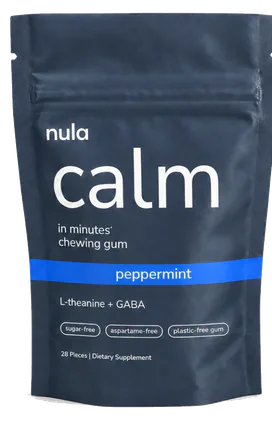
Nula Calm Gum
100 mg L-theanine + 50 mg GABA in every piece. caffeine-free. chew 1–2 pieces for at least three minutes.
shop calm