It's 11:47 PM. You're lying in the dark, exhausted, but your brain is running a highlight reel of everything you said wrong today, everything due tomorrow, and a conversation from three years ago that apparently still matters. You flip the pillow to the cool side. Check the clock. Tell yourself to stop thinking. That makes it worse. Now you're thinking about thinking. The harder you try to shut your mind off, the louder it gets — looping, spiraling, replaying moments you can't change at an hour when you can't do anything about them.
This isn't a discipline problem. It's a nervous system problem. And there are fast ways to interrupt it.
Why Your Brain Won't Shut Off at Night
During the day, your attention has somewhere to go. Tasks, conversations, screens, movement — all of it gives your brain a target. At night, those anchors disappear. The room is dark. The house is quiet. And your brain, suddenly unoccupied, fills the silence with unfinished business.
What you're experiencing has a neurological basis. When external stimulation drops, your brain's default mode network activates — the same network responsible for self-reflection, rumination, and mental time travel. Your autonomic nervous system can also re-engage its sympathetic branch, nudging your body back toward a low-grade stress response even though you're lying still.
Here's what that looks like at bedtime:
-
Looping thoughts that circle back no matter how many times you dismiss them
-
Replaying conversations and rewriting what you should have said
-
Future-planning spirals about tomorrow, next week, or things you can't control
-
Physical tension you didn't notice earlier — tight jaw, clenched fists, stiff shoulders
-
Heart rate that feels too fast for someone lying perfectly still
The key insight: the problem isn't that something is wrong with you. It's that your brain doesn't have a landing pad. Without a focal point, it defaults to scanning for threats, unfinished tasks, and unresolved emotions. The fix isn't to empty your mind — it's to give it somewhere specific to land.
6 Ways to Stop Overthinking at Night
These techniques are designed to work in bed, in the dark, without needing to get up. Each one gives your brain a new focal point so it stops defaulting to the thought loop.
1. Extended Exhale Breathing
The simplest nervous system intervention you can do without moving.
How to do it:
-
Inhale gently through your nose for 4 seconds
-
Exhale slowly through your mouth for 6-8 seconds
-
Focus on making the exhale longer than the inhale
-
Repeat for 5 cycles (about 60 seconds)
Why it works: Longer exhales activate the vagus nerve, which triggers your parasympathetic nervous system — the branch responsible for rest and recovery. Research from Stanford's Huberman Lab has demonstrated that this extended exhale pattern, sometimes called a "physiological sigh," is one of the fastest ways to down-regulate sympathetic activation in real time. Unlike equal-ratio breathing, the longer exhale specifically signals safety to your brainstem. You can do this lying flat, eyes closed, without any app or timer.
2. The "Download" — Write It All Down
When thoughts are looping, they're often trying to be remembered. Writing them down tells your brain the job is done.
How to do it:
-
Keep a notepad and pen on your nightstand (not your phone)
-
When thoughts start racing, sit up and write for 2 minutes — no structure, no editing
-
Write everything: tasks, worries, random fragments, half-formed fears
-
Close the notepad and lie back down
Why it works: A 2018 study published in the Journal of Experimental Psychology found that participants who wrote a to-do list before bed fell asleep significantly faster than those who wrote about completed tasks. The act of externalizing unfinished business reduces the cognitive load your brain is carrying. Once thoughts are on paper, the mental loop loses its urgency — your brain no longer needs to keep rehearsing them to prevent forgetting.
3. Body Scan From Head to Toes
This redirects attention from thoughts to physical sensation, which uses a different neural pathway and breaks the rumination loop.
How to do it:
-
Start at the top of your head — notice any tension, warmth, or pressure
-
Move slowly down: forehead, eyes, jaw, neck, shoulders
-
Continue through chest, arms, hands, stomach, hips, legs, feet
-
At each point, don't try to fix the tension — just notice it
-
Spend about 2-3 seconds per body part
Why it works: Body scanning engages your interoceptive awareness — your brain's ability to sense internal body states. This pulls neural resources away from the default mode network (where rumination lives) and toward the somatosensory cortex. Research published in Frontiers in Psychology has shown that body scan practices reduce pre-sleep cognitive arousal. The key is that you're not trying to relax each body part — you're simply noticing it. The noticing itself is what redirects the brain.
4. Cognitive Shuffle
Think of random, unrelated images in sequence. That's it. It sounds too simple, but it works.
How to do it:
-
Picture a random object: an apple
-
Then an unrelated one: a shovel
-
Then another: the ocean
-
Then another: a yellow hat
-
Keep going — the images should have no logical connection to each other
-
Don't tell a story. Just let each image appear and dissolve.
Why it works: The cognitive shuffle was developed by Luc Beaudoin, a cognitive scientist at Simon Fraser University. The technique works because your brain interprets random, non-threatening imagery as a signal that it's safe to disengage. Logical, sequential thinking keeps the prefrontal cortex active — exactly what you don't want at bedtime. By feeding your brain images that don't connect, you bypass the analytical circuits and mimic the fragmented, associative thinking that naturally precedes sleep onset.
5. Name the Loop (Affect Labeling)
Instead of fighting the thought, label it. "I'm replaying the meeting again." That single sentence changes your relationship to the thought.
How to do it:
-
When you catch yourself spiraling, pause and name what's happening
-
Use a simple, neutral statement: "I'm rehearsing tomorrow's conversation."
-
Or: "I'm replaying what I said at dinner."
-
Or: "I'm worrying about money again."
-
Say it once, internally. Don't elaborate. Then return to breathing or body scanning.
Why it works: Neuroscience research from UCLA has shown that putting feelings and thoughts into words — a process called affect labeling — reduces activity in the amygdala, the brain's threat-detection center. When you name the loop, you shift from being inside the thought to observing it. That small distance is enough to weaken its grip. You're not suppressing the thought. You're acknowledging it without engaging further.
6. Temperature Shift
A subtle change in body temperature can trigger your body's natural sleep signals.
How to do it:
-
Keep your bedroom cool — between 60-67°F (15-19°C) is optimal
-
Place a cool cloth or cold gel pack on your forehead when thoughts start racing
-
Alternatively, stick one foot out from under the covers
-
If you have cold hands, place them briefly on your neck or cheeks
Why it works: Your core body temperature needs to drop by about 2-3°F for sleep onset. Cooling the forehead specifically targets the prefrontal cortex, the area most active during rumination. A study in the American Journal of Psychiatry found that frontal cerebral thermal transfer (cooling the forehead) helped insomnia patients fall asleep faster. The cold sensation also provides a competing physical stimulus that pulls attention away from mental loops, similar to the body scan but with a sharper sensory anchor.
The 60-Second Nighttime Reset
If you want a single fast routine, use this sequence. It combines the most effective techniques in under 90 seconds.
| Step | Action | Time |
| 1 | Extended exhale breathing — inhale 4 sec, exhale 6-8 sec, 5 cycles | 30 sec |
| 2 | Name the loop — "I'm replaying the meeting" or "I'm planning tomorrow" | 5 sec |
| 3 | Body scan — head to toes, noticing tension without fixing it | 20 sec |
| 4 | Cognitive shuffle — random unrelated images until you drift | Ongoing |
Start with the exhale to slow your nervous system. Name the loop to break identification with the thought. Scan your body to redirect attention. Then let the cognitive shuffle carry you toward sleep. Most people don't make it past the first few minutes of the shuffle.
Why Speed Matters
Overthinking at night compounds. The longer you lie there caught in a thought loop, the more frustrated you become — and that frustration becomes its own layer of stress. Now you're not just overthinking. You're overthinking about overthinking. You're angry at yourself for not sleeping. You're calculating how many hours of sleep you'll get if you fall asleep right now. Each minute adds weight.
Fast intervention breaks the cycle before it deepens. The first 30-60 seconds after you notice the loop are the most important. That's when the thought is still loosely held — it hasn't yet calcified into a full anxiety spiral. Catching it early with a breath pattern, a label, or a body scan is significantly more effective than trying to dismantle a spiral that's been building for 45 minutes.
The goal isn't perfection. It's early interruption. Redirect once, redirect quickly, and let the body's own sleep drive take over from there.
When Nighttime Overthinking Hits Hardest
Nighttime overthinking isn't random. It tends to spike in specific situations:
-
After a stressful workday — unprocessed meetings, emails, and deadlines flood back once the distractions stop
-
Before a big event tomorrow — presentations, interviews, difficult conversations, or early flights create anticipatory loops
-
After an argument or tense conversation — your brain replays the exchange, rewriting lines and rehearsing responses you'll never give
-
During financial stress — numbers, bills, and "what if" scenarios cycle with particular intensity at night
-
After embarrassing moments — social mistakes that seemed small at the time become amplified in the dark
-
During life transitions — moving, changing jobs, ending or starting relationships, or any period of uncertainty
-
Sunday night anxiety — the anticipation of the week ahead creates a specific, predictable pattern of overthinking that peaks between Sunday evening and Monday morning
Each of these scenarios shares a common thread: unresolved cognitive load meeting an absence of distraction. The brain has unfinished processing, and nighttime is the first moment it has the bandwidth to run it all.
A routine for the evening
If your thoughts keep looping, you might write down what needs attention tomorrow and put the note aside. Choose a routine that does not depend on buying a product or meeting a deadline for sleep. Nula is not a sleep aid.
When to Seek Professional Support
Occasional nighttime overthinking is a normal human experience. But if your racing thoughts at night:
-
Happen most nights for weeks or months at a time
-
Cause significant sleep deprivation that affects your daily functioning
-
Are accompanied by persistent worry, dread, or panic that extends into daytime hours
-
Involve intrusive thoughts that feel disturbing or difficult to control
-
Co-occur with other symptoms like rapid heartbeat, sweating, or chest tightness at rest
...it may be worth speaking with a healthcare provider or mental health professional. Chronic insomnia, generalized anxiety disorder, and other treatable conditions can present as persistent nighttime overthinking. Cognitive behavioral therapy for insomnia (CBT-I) is considered the gold-standard treatment and has strong research support.
The techniques in this article are designed for situational nighttime overthinking, not as a replacement for professional care.
Frequently Asked Questions
How do I stop my mind from racing at night?
Start with extended exhale breathing — inhale for 4 seconds, exhale for 6-8 seconds, and repeat for 5 cycles. This activates the parasympathetic nervous system and signals your body to downshift from alert mode. If the thoughts persist, name the loop (e.g., "I'm replaying tomorrow's meeting"), then shift to a body scan or cognitive shuffle. The combination of slowing your breathing, labeling the thought, and redirecting your focus addresses the three main drivers of nighttime racing thoughts: physiological arousal, cognitive identification, and attentional fixation.
Why do I overthink more at night than during the day?
During the day, your attention is occupied by tasks, conversations, and external stimulation. At night, those anchors disappear. Your brain's default mode network — the neural network responsible for self-referential thinking and rumination — becomes more active when external input drops. Simultaneously, without distractions to buffer it, unprocessed stress from the day surfaces. The quiet, dark environment removes every competing stimulus, giving anxious thoughts an open stage. This is a normal neurological pattern, not a personal failing.
Is overthinking at night a sign of anxiety?
It can be, but not always. Occasional nighttime overthinking — especially after stressful days, before big events, or during life transitions — is a common human experience. It becomes a potential sign of clinical anxiety when it happens persistently (most nights over several weeks), significantly disrupts sleep, carries into daytime worry, or involves intrusive thoughts that feel difficult to control. If your nighttime overthinking is chronic and impairing, speaking with a mental health professional can help distinguish between normal stress responses and conditions like generalized anxiety disorder or insomnia.
How do I stop replaying conversations in my head at night?
Conversation replaying is one of the most common forms of nighttime rumination. The fastest interrupt is affect labeling: name what's happening without judgment. Say to yourself, "I'm replaying the conversation with my manager again." This shifts you from being inside the loop to observing it, which reduces amygdala activation. Then redirect your attention to a body scan or cognitive shuffle. Writing the conversation down briefly (the "download" technique) can also help — once it's on paper, your brain releases the need to keep rehearsing it.
What is the cognitive shuffle technique?
The cognitive shuffle is a technique developed by cognitive scientist Luc Beaudoin at Simon Fraser University. You think of a random object (e.g., a red bicycle), then an unrelated one (e.g., a cloud), then another (e.g., a wooden spoon), and continue generating random, disconnected images. The images should have no logical connection to each other and no narrative thread. This works because random, non-threatening imagery mimics the fragmented thinking that naturally occurs as you fall asleep. It disengages the analytical prefrontal cortex — the part of your brain that drives rumination — and allows your sleep drive to take over.
Can breathing exercises help you fall asleep?
Yes. Extended exhale breathing is one of the most well-supported techniques for reducing pre-sleep arousal. Research from Stanford's Huberman Lab has shown that exhale-dominant breathing patterns activate the vagus nerve and shift the autonomic nervous system from sympathetic (alert) to parasympathetic (rest) mode. The key is making the exhale longer than the inhale — a 4-second inhale with a 6-8-second exhale is a reliable ratio. Five cycles take about 60 seconds and can measurably lower heart rate and reduce the physiological activation that keeps you awake. It won't force sleep, but it creates the physical conditions that allow sleep to arrive.
Key Takeaway
Longer exhale. Name the loop. Scan your body. Let the thoughts blur.
You don't need to empty your mind to fall asleep. You just need to redirect it — give it a landing pad that isn't the thought spiral. One breath pattern, one label, one shift in attention. That's usually enough to break the cycle and let your body's own sleep drive do the rest.
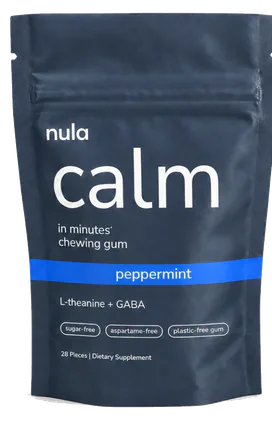
Nula Calm Gum
100 mg L-theanine + 50 mg GABA in every piece. caffeine-free. chew 1–2 pieces for at least three minutes.
shop calm