Why Your Brain Blanks Before an Exam
Test anxiety is not a character flaw or a sign that you did not study enough. It is a specific form of performance anxiety — a well-documented stress response that narrows the exact cognitive resource you need most during an exam: working memory.
Here is what happens. When your brain perceives a high-stakes threat (and yes, an exam qualifies), it triggers the autonomic nervous system. The sympathetic branch activates. Cortisol and adrenaline flood the prefrontal cortex — the part of the brain responsible for recall, reasoning, and organized thinking. Blood flow shifts toward survival-oriented systems. Your higher-order thinking dims.
The result is a predictable cluster of symptoms:
-
Mind going blank — you stare at a question you know you studied
-
Racing heart — elevated pulse even while sitting still
-
Sweaty palms — autonomic arousal redirecting blood flow
-
Nausea or stomach tightness — the gut-brain axis responding to perceived threat
-
Inability to focus on the first question — attention scatters under cortisol load
-
Urge to rush through — the fight-or-flight system wants the threat to end fast
Here is the key insight: the material is still in your brain. The stress response is not erasing your knowledge — it is blocking access to it. The information is stored in long-term memory. Cortisol is simply interfering with the retrieval pathway. Lower the physiological arousal, and recall comes back online.
That is what the techniques below are designed to do.
6 Ways to Calm Down Before an Exam
These are not vague tips. Each one targets the nervous system directly — lowering cortisol, freeing working memory, or redirecting attention away from threat and toward task. Use one. Use three. Use them in sequence. They work best in the final minutes before the exam starts or in the first sixty seconds after you open the test booklet.
1. Extended Exhale Breathing
How to do it: Inhale through your nose for 4 seconds. Exhale slowly through your mouth for 6 to 8 seconds. Repeat for 5 cycles. You can do this at your desk, in the hallway, or in your seat while the exam is being distributed.
Why it works: When your exhale is longer than your inhale, you activate the parasympathetic nervous system — the branch responsible for calming the body down. Research published in Frontiers in Human Neuroscience has shown that slow, controlled breathing reduces cortisol levels and lowers heart rate within minutes. This is the single fastest lever you have to shift your nervous system state before an exam. No one around you will even notice you are doing it.
2. Expressive Writing (The Worry Dump)
How to do it: Take a piece of scrap paper — or the margins of your exam if allowed — and spend 2 minutes writing down every worry running through your mind. "I am going to forget everything." "I did not study chapter 7 enough." "If I fail this I will lose my GPA." Write it all. Then set the paper aside.
Why it works: Research from the University of Chicago, led by psychologist Sian Beilock, found that students who wrote about their anxieties for 10 minutes before a high-stakes exam performed significantly better than those who did not. Even a shorter version of this exercise — just 2 minutes — helps. The mechanism is straightforward: worries consume working memory. When you externalize them onto paper, you free up cognitive bandwidth for the actual test. The worries do not disappear, but they stop looping inside the system you need for problem-solving.
3. Progressive Muscle Release
How to do it: Clench both fists as tightly as you can. Hold for 5 seconds. Release. Notice the contrast between tension and relaxation. Repeat once. Then do the same with your shoulders — lift them toward your ears, hold for 5 seconds, drop. You can do this silently in any exam setting.
Why it works: Progressive muscle relaxation works by giving the body a physical signal that the threat is over. When muscles release after deliberate tension, the nervous system interprets it as a shift from danger to safety. This technique has been used in clinical anxiety treatment for decades and is one of the few physical interventions you can perform in a seated, silent exam environment without drawing attention. It also releases physical tension you may not realize you are holding — jaw, shoulders, hands — which contributes to the overall feeling of being "locked up."
4. Start With What You Know
How to do it: When you open the exam, do not start with question one. Scan the test. Find a question you are confident about — one where the answer comes to you without strain. Answer it first. Then move to the next easiest. Build from there.
Why it works: Answering a question correctly generates a small dopamine release — a neurochemical reward that shifts the brain from threat mode to engagement mode. This is not just a motivational trick. It is a genuine cognitive reset. Once you prove to your nervous system that you do know things, the retrieval pathways begin to open. Momentum matters. The first answer you write shapes the neurochemical environment for every answer that follows. Starting with a hard question while already anxious compounds the freeze. Starting with a known answer breaks it.
5. Ground With Your Senses
How to do it: Press your feet flat on the floor. Feel the weight of the pen in your hand. Notice the texture of the desk under your forearm. Look at the room — the walls, the clock, the window. Name three things you can physically feel right now. This takes less than 10 seconds.
Why it works: Sensory grounding pulls your attention out of the internal threat loop and into the present physical environment. Anxiety lives in the future — "what if I fail," "what if I blank," "what if I run out of time." Your senses live in the present. By deliberately shifting attention to physical sensation, you interrupt the catastrophic thought cycle and bring your prefrontal cortex back into contact with the here and now. This technique is widely used in clinical settings for panic and acute anxiety episodes.
6. Reframe the Moment
How to do it: Before the exam begins, say one line to yourself — silently or under your breath: "This tests what I remember, not what I am worth." Or: "I have prepared. This is a retrieval exercise, not a judgment." Choose a version that resonates. Repeat it once.
Why it works: Cognitive reframing does not eliminate anxiety, but it changes the relationship between you and the stressor. Research in cognitive behavioral therapy has consistently shown that reappraising a threatening situation as a challenge (rather than a verdict) reduces the cortisol response and improves performance. When you remind yourself that an exam is a test of recall — not a measure of your intelligence, your future, or your value — you lower the perceived stakes just enough for your thinking brain to stay online.
The 60-Second Pre-Exam Reset
If you only have a minute before the exam starts, use this sequence:
| Step | Action | Time |
| 1 | Extended exhale breathing — 5 cycles (in for 4, out for 6-8) | 30 seconds |
| 2 | Write worries on scrap paper (optional, if time and materials allow) | 2 minutes |
| 3 | Clench and release fists once, then shoulders once | 10 seconds |
| 4 | Scan the exam and start with the easiest question | — |
You do not need all four. Even step one alone — 30 seconds of controlled breathing — can shift your nervous system enough to unlock recall. The goal is not to feel perfectly calm. The goal is to feel calm enough to start.
Why Speed Matters
Exam anxiety peaks in the first 2 to 3 minutes. Research on test performance consistently shows that the initial moments of an exam carry disproportionate weight — not because the first questions are harder, but because the stress response is at its highest before you begin writing.
If you can bring your nervous system down even slightly before starting, working memory comes back online. Recall improves. The urge to rush decreases. You begin reading questions accurately instead of scanning them in panic.
The longer you sit frozen — staring at a question, rereading the same line, feeling your heart rate climb — the more time you lose and the more the panic builds on itself. Anxiety feeds on inaction. The techniques above are designed to break that loop in under a minute, so you can start writing before the freeze sets in.
The first 60 seconds are the intervention window. Use them.
When Exam Anxiety Hits
These techniques apply across a wide range of testing situations. If you experience pre-exam nerves in any of the following, the same nervous system reset works:
-
Final exams — cumulative tests with high grade weight
-
Standardized tests — SAT, ACT, GRE, LSAT, MCAT, GMAT
-
Certification exams — professional credentials, technical certifications
-
Driving tests — written and behind-the-wheel
-
Professional licensing exams — bar exam, medical boards, nursing boards, CPA
-
Pop quizzes — sudden testing with no preparation window
-
Oral exams and thesis defenses — performance anxiety compounded by social evaluation
The underlying mechanism is the same in every case: a high-stakes performance situation triggers sympathetic activation, which suppresses working memory. The format changes. The nervous system response does not.
A Note on Exam-Day Tools
Before exam day, choose a routine you can remember: a comfortable breath, a written cue card, or a short pause before reading the first question. Practise it during a study session. A familiar routine gives you one less decision to make at the desk; it does not guarantee a particular result or response time.
Frequently Asked Questions
How do I calm down before an exam quickly?
The fastest method is extended exhale breathing: inhale for 4 seconds, exhale for 6 to 8 seconds, repeat for 5 cycles. This activates the parasympathetic nervous system and can lower heart rate and cortisol within 30 seconds. Pair it with a brief sensory grounding exercise — press your feet into the floor, feel the pen in your hand — to pull your attention into the present moment and out of anticipatory worry.
Why does my mind go blank during tests?
Your mind goes blank because cortisol — the primary stress hormone — floods the prefrontal cortex under perceived threat. This suppresses the retrieval pathways that connect your working memory to stored knowledge. The information is still in your brain. The stress response is blocking access. This is why students often remember answers immediately after leaving the exam room — once the threat is removed, the cortisol drops and recall returns.
Is test anxiety a real condition?
Yes. Test anxiety is a recognized form of performance anxiety supported by decades of research in educational psychology and clinical psychology. It involves both cognitive symptoms (worry, negative self-talk, mind blanking) and physiological symptoms (elevated heart rate, sweating, nausea, muscle tension). For some individuals, test anxiety is severe enough to significantly impact academic performance despite adequate preparation. If test anxiety consistently interferes with your ability to demonstrate what you know, consider speaking with a counselor or psychologist who specializes in performance anxiety.
How do I stop panicking during an exam?
If panic hits mid-exam, pause. Put the pen down. Do 3 to 5 cycles of extended exhale breathing (in for 4, out for 6-8). Clench your fists for 5 seconds, then release. Ground yourself by pressing your feet into the floor and noticing the physical sensations around you. Then skip to a question you feel confident about and answer it. This sequence interrupts the panic cycle by engaging the parasympathetic nervous system and generating a small success experience that shifts your brain from threat mode to task mode.
Does writing down your worries before a test actually help?
Yes, and there is strong research to support it. A study led by Sian Beilock at the University of Chicago found that students who spent 10 minutes writing about their testing anxieties before a high-stakes exam improved their performance — particularly students who were most prone to test anxiety. The mechanism is working memory: anxious thoughts occupy the same cognitive resources you need for problem-solving. Writing them down externalizes the worry and frees up mental bandwidth. Even a shorter 2-minute version of this exercise can help.
Can breathing exercises improve test performance?
Controlled breathing — specifically patterns where the exhale is longer than the inhale — has been shown to reduce physiological arousal markers including heart rate, blood pressure, and cortisol levels. While breathing alone does not improve knowledge or preparation, it directly addresses the nervous system activation that blocks recall during exams. By lowering arousal, breathing exercises restore access to working memory and long-term memory retrieval. In practical terms, this means you are more likely to remember what you studied and less likely to misread questions or rush through answers.
Longer exhale. Write the worry down. Start with what you know. The material is still there.
You did the work. The freeze before the exam is not a sign that you are unprepared — it is a sign that your nervous system is doing exactly what it was designed to do under threat. The difference is that this threat does not require you to run. It requires you to think. And thinking comes back the moment you give your body the signal that it is safe enough to start.
If test anxiety is significantly affecting your academic performance or daily well-being, consider speaking with a mental health professional. Performance anxiety is treatable, and you do not have to manage it alone.
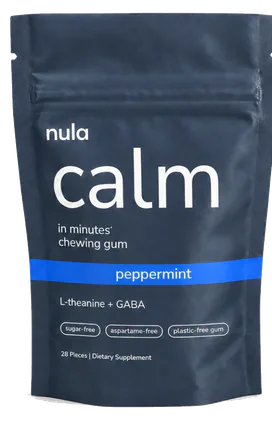
Nula Calm Gum
100 mg L-theanine + 50 mg GABA in every piece. caffeine-free. chew 1–2 pieces for at least three minutes.
shop calm