Slides ready. Room watching. Your name about to be called. If you've ever felt your hands shake and your breath shorten right before presenting, you already know: this isn't normal everyday stress. This is performance stress, and it hits differently.
You prepared for the content. Your body prepared for a threat. The goal isn't to remove adrenaline. The goal is to control it so your delivery stays steady. This guide covers how to calm down before a presentation using fast, practical techniques you can use backstage, in a hallway, or while waiting for your turn. Most work in under 2 minutes.
Why Do You Get So Nervous Before a Presentation?
Presentations trigger a specific kind of stress response. Your autonomic nervous system reads group attention as social pressure and shifts into sympathetic activation, commonly known as fight-or-flight mode.
Unlike general work stress, presentation anxiety is tied to visibility. Your brain detects a room full of eyes and interprets it as evaluation. That triggers a cascade of physical responses designed for survival, not for speaking clearly.
Here's what that looks like:
-
Adrenaline surge that makes your hands tremble and your heart pound
-
Faster speech as your nervous system tries to rush through the perceived threat
-
Tight jaw or throat from muscles locking in anticipation
-
Shallow breathing because your body is preparing for physical action, not conversation
-
Over-awareness of yourself where you notice every micro-movement you make
According to the National Institute of Mental Health, roughly 73% of people experience some degree of public speaking anxiety. The National Social Anxiety Center lists fear of public speaking as the most common phobia, ahead of heights and spiders.
Here's what matters: you don't need to calm down completely. You just need to slow the system enough to stay in control of your voice, your pacing, and your first few sentences. That's a much lower bar, and it's reachable in under two minutes.
A 2-Minute Pre-Presentation Reset
This reset is built for the real window before a presentation. Not for an hour before. Not for the night before. For the 2-3 minutes right before you speak.
It focuses on three things: voice, pacing, and physical control. You can do it backstage, in a hallway, at your seat, or standing next to a podium.
Step 1: Breathe for Cadence (Not Just Calm)
Most breathing advice tells you to "take deep breaths." That's too vague. What actually works before presenting is breathing that syncs with speech rhythm.
How to do it:
-
Inhale through your nose for 4 seconds
-
Exhale slowly through your mouth for 6 seconds
-
After the exhale, say one sentence out loud, slowly
-
Repeat for 3-5 breath cycles
Why it works: Longer exhales activate your vagus nerve, which triggers your parasympathetic nervous system and directly counteracts the fight-or-flight response. Research from Stanford's Huberman Lab has shown this "physiological sigh" pattern is one of the fastest real-time stress interventions available. Adding a spoken sentence after the exhale trains your voice to match the slower rhythm, so when you start your presentation, the pacing carries over.
Step 2: Decide to Start Slower Than Feels Natural
Speed is the first thing that breaks during a nervous presentation. Your body wants to rush. If you don't override that instinct before you begin, your first minute will be too fast, and you'll spend the rest of the presentation trying to recover.
How to do it:
-
Before you start, tell yourself: "I will speak slower than feels natural for the first 60 seconds."
-
Don't try to slow down mid-presentation. Set the pace before your mouth opens.
-
Your first minute sets the rhythm for everything that follows.
Why it works: When you're under adrenaline, your internal speedometer is off. What feels "normal" to you sounds rushed to the audience. Deliberately choosing a slower start compensates for that gap. Audiences perceive slower opening pacing as confidence. Rushed pacing reads as nerves.
Step 3: Release Your Mouth and Jaw
Tension collects in the jaw, tongue, and throat before presenting, and it directly affects how your voice sounds. A tight jaw creates a thin, strained voice. A relaxed jaw produces a fuller, steadier tone.
How to do it:
-
Open your mouth wide once, then close it gently
-
Let your tongue sit flat and loose on the bottom of your mouth
-
Unclench your back teeth
-
If you can, hum quietly for 3 seconds to feel the vibration in your chest
Why it works: Matt Abrahams at Stanford recommends tongue twisters and vocal warm-ups before speaking to reduce voice tension. The jaw release is a simpler version of the same principle. When the muscles around your vocal cords relax, your voice drops into its natural register, which sounds more composed and authoritative.
Step 4: Anchor Your Stance
Fidgeting, swaying, and shifting weight are visible signs of nervousness. They also feed back into your nervous system, signaling that something is wrong. Stillness breaks that loop.
How to do it:
-
Plant both feet flat on the floor, hip-width apart
-
Distribute your weight evenly between both legs
-
Let your hands rest at your sides or on the podium
-
Hold this position for 10 seconds before you begin
Why it works: Physical stability sends a signal to your brain that the environment is safe. Research on embodied cognition shows that your posture influences your emotional state, not just the other way around. When your body is still, your brain reads "no threat." That lowers the intensity of the stress response.
A Quick Reference: The 2-Minute Reset
| Step | Action | Time |
| 1 | Breathe for cadence — 4-second inhale, 6-second exhale, then one slow sentence | 45 sec |
| 2 | Set your pace — decide to speak slower than natural for the first 60 seconds | 10 sec |
| 3 | Release jaw and mouth — open wide, close gently, relax tongue | 10 sec |
| 4 | Anchor your stance — feet planted, weight even, hold for 10 seconds | 15 sec |
Total: under 2 minutes. Most people feel noticeably more in control after this sequence.
Why Speed Is What Breaks Presentations (Not Nerves)
Presentations don't fall apart because you're nervous. They fall apart when speed outruns control.
Almost every presenter feels some level of nervousness. That's normal. The problem starts when that nervous energy accelerates your speech, which shortens your breath, which tightens your throat, which scatters your thinking. It's a chain reaction, and speed is the first link.
When breathing slows down, the chain reverses:
-
Your voice steadies
-
Your pacing improves
-
Your working memory returns
-
Your delivery sounds confident
You don't need zero anxiety. You need controlled energy: enough adrenaline to keep you sharp, but not so much that it takes over your delivery.
This is why the reset above focuses on pacing and breath rhythm instead of "relaxation." Relaxation is a long-term goal. Pacing control is a 2-minute intervention.
Why Most "Calm Down" Advice Fails Before Presentations
Most anxiety management techniques are built for different timelines:
-
Journaling works after the stressful event
-
Exercise helps if you do it hours before
-
Meditation works with consistent daily practice
-
Supplements need time to take effect
-
Therapy techniques develop over weeks
Those are all valuable tools. But presentations have a clear start time. You usually get a short window, sometimes just a few minutes, to steady yourself before you speak. Tools that need 20 minutes or consistent daily practice don't match that window.
That's why moment-specific techniques matter most here. You need tools that work in the 2-3 minute gap between "you're up next" and walking to the front of the room.
The best approach for how to not be nervous for a presentation is building a small, repeatable pre-presentation routine:
-
One breathing pattern you always use
-
One posture cue (feet planted, weight even)
-
One pacing decision (slower than natural)
-
A habit of arriving 2 minutes early to run through the sequence
Not for daily use. Just for the minutes before you speak.
When Presentation Anxiety Is More Than Pre-Speech Nerves
Normal pre-presentation nervousness is extremely common. But if your anxiety:
-
Causes you to avoid or cancel presentations entirely
-
Creates severe physical symptoms like nausea, dizziness, or panic attacks
-
Lasts well beyond the presentation itself (hours or days after)
-
Gets worse over time rather than improving with experience
-
Interferes with your career because you can't present when you need to
...it may be worth speaking with a mental health professional. These could be signs of social anxiety disorder or a specific phobia (glossophobia), both of which respond well to treatment including cognitive behavioral therapy and, in some cases, medication.
The Mayo Clinic offers guidance on distinguishing normal public speaking nervousness from clinical anxiety that benefits from professional support.
The techniques in this article are designed for normal situational nervousness before presenting, not as a substitute for professional care.
Frequently Asked Questions
What is the fastest way to calm down before a presentation?
The fastest method is extended exhale breathing: inhale for 4 seconds, exhale for 6 seconds, and repeat for 3-5 cycles. This activates your vagus nerve and shifts your nervous system out of fight-or-flight mode in under 60 seconds. Pair it with a jaw release and anchoring your stance for the full 2-minute reset.
Why do I get so nervous before presentations but not in normal conversations?
Presentations trigger a visibility response that casual conversations don't. Your brain reads group attention as social evaluation and activates the sympathetic nervous system. In one-on-one conversations, the perceived stakes are lower. Roughly 73% of people experience some degree of this response before public speaking, making it one of the most common stress triggers.
How do I stop my voice from shaking before a presentation?
Voice shaking comes from tension in the jaw, throat, and diaphragm. To counter it: release your jaw by opening your mouth wide once and closing gently, relax your tongue, and take 3-5 breath cycles with extended exhales. Speaking your first sentence out loud before you begin also helps your vocal cords warm up and settle into a steadier rhythm.
Is it better to try to calm down or reframe anxiety as excitement?
Research from Harvard Business School found that people who reframed anxiety as excitement performed better in stressful tasks than those who tried to suppress nervousness. The physical sensations (elevated heart rate, adrenaline, alertness) are nearly identical for both emotions. Telling yourself "I'm ready" or "this energy means I'm prepared" can shift the experience without fighting the physical response.
How do I calm down before a presentation at work?
Use the 2-minute pre-presentation reset: breathe with extended exhales for 45 seconds, decide to speak slower than natural for your first minute, release tension in your jaw and mouth, and anchor your stance with feet planted and weight even. If possible, arrive at the room 2 minutes early so you have a buffer to run through this routine without rushing.
Can I use these techniques for virtual presentations and Zoom calls?
Yes. The breathing and pacing techniques work the same way for virtual presentations. Before joining, do the exhale cycle at your desk. While in the waiting room or during the introduction, anchor your posture in your chair (feet flat, back supported, shoulders dropped). Set your pacing intention before you unmute. The jaw release works especially well before virtual calls since nobody can see you do it.
Key Takeaway
Before you present:
Longer exhale. Start slower. Jaw released. Feet grounded. Control pace first.
You don't need to feel perfectly calm. You just need to feel steady enough to deliver your first few sentences clearly. That's the only bar that matters, and it's one you can hit in 2 minutes.
Confidence usually follows control. Get the pacing right, and the rest tends to take care of itself.
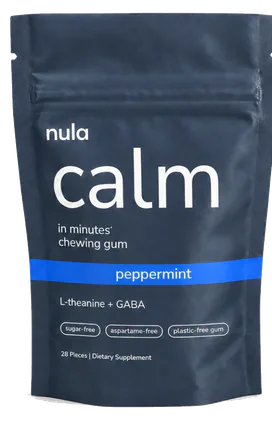
Nula Calm Gum
100 mg L-theanine + 50 mg GABA in every piece. caffeine-free. chew 1–2 pieces for at least three minutes.
shop calm