The phone is about to ring. Or worse — you need to make the call. Your finger hovers over the dial button. You rehearse the opening line in your head. You put it off for ten more minutes. Then twenty. You tell yourself you'll do it after lunch, after this next task, after you've had time to "prepare" — even though there's nothing left to prepare.
Whether it's a work call, a doctor's office, or a conversation you've been avoiding, the dread is real and specific. It's not laziness. It's not a personality flaw. It's pre-call anxiety — and it's far more common than most people admit. This guide covers fast, science-backed techniques to calm down before a phone call so you can actually pick up.
Why Phone Calls Trigger Anxiety
Phone calls strip away every visual cue your brain relies on to feel safe in a conversation. There are no facial expressions to read. No body language to gauge. No pauses where you can see the other person nodding along. Your brain, wired to scan for social threat, can't get the data it needs — so it fills the gaps with worst-case predictions.
This triggers your autonomic nervous system into sympathetic activation — the same fight-or-flight response you'd feel before a physical threat. Except the threat here is uncertainty and real-time performance pressure.
That's why phone call anxiety can look like:
-
Heart rate spike before dialing — adrenaline release preparing your body for action that never comes
-
Dry mouth — a classic sympathetic nervous system response
-
Racing thoughts about what to say — your brain rehearsing and catastrophizing simultaneously
-
Avoidance behavior — putting the call off for hours, days, or indefinitely
-
Shallow, chest-level breathing — your body shifting to rapid respiration under perceived stress
Here's the key insight: phone anxiety is about uncertainty and performance pressure compressed into real time. Unlike a text or email, you can't pause, edit, or delete. Every word is live. That's what makes calls feel so much harder — and why your nervous system treats them like a threat.
5 Ways to Calm Pre-Call Anxiety Fast
These techniques are built for the 30–90 seconds before you dial. No quiet room required. No app. Just fast switches you can use with the phone already in your hand.
1. Extended Exhale Breathing (With the Phone in Your Hand)
This is the single most effective way to calm down before a phone call quickly.
How to do it:
-
Hold your phone in your hand — don't put it down
-
Inhale normally through your nose (3–4 seconds)
-
Exhale slowly through your mouth (6–8 seconds)
-
Repeat for 5 breath cycles
-
Dial on the last exhale
Why it works: Longer exhales activate your vagus nerve, which triggers the parasympathetic nervous system — the "rest and digest" counterpart to fight-or-flight. Research from Stanford University's Huberman Lab has shown that this "physiological sigh" pattern is one of the fastest real-time stress interventions available. Doing it with the phone in your hand keeps you in the action instead of using the breathing as another delay tactic.
2. Write Your First Sentence Down
The hardest part of any call is the opening. Remove that pressure entirely.
How to do it:
-
Before you dial, write down exactly what you'll say first
-
Keep it simple: "Hi, this is [name], I'm calling about..."
-
Don't script the whole call — just the first line
-
Have it visible on your screen or a sticky note when you dial
Why it works: A huge portion of anxiety before phone calls comes from the "how do I start" problem. Your brain loops on the opening, trying to find the perfect phrasing, which burns cognitive resources and deepens the dread. Writing it down externalizes the problem. You no longer have to hold it in working memory, so your brain can let go of the rehearsal loop.
3. Stand Up and Move
Sitting still while anxious reinforces the freeze response. Your body has energy to burn — let it.
How to do it:
-
Stand up from your chair
-
Pace slowly while you dial or wait for the call
-
If you can't pace, shift your weight from foot to foot
-
Let your hands move naturally — hold the phone, don't grip it
Why it works: Anxiety generates physical energy through adrenaline and cortisol. When you sit still, that energy has nowhere to go and amplifies the internal tension. Standing and moving channels the activation into motion, which your nervous system reads as action rather than threat. Many people instinctively pace during phone calls for exactly this reason — it works because it matches your body's state to the situation.
4. Reframe the Call
Your brain is treating this like a performance. Remind it that it's a conversation.
How to do it:
-
Before dialing, tell yourself: "This is a conversation, not a test"
-
Remind yourself that the other person isn't scoring your performance
-
If it's a routine call (appointment, customer service), remind yourself they take hundreds of these a day — yours is not memorable to them
-
Lower the stakes mentally: "The only goal is to say what I need to say"
Why it works: Phone anxiety escalates when your brain frames the call as a high-stakes evaluation. Reframing it as a simple exchange — two people talking — reduces the perceived threat. Research on cognitive reappraisal shows that changing how you interpret a situation changes the emotional response, even without changing the situation itself. You're not lying to yourself. You're correcting a distortion.
5. Set a Post-Call Reward
Give your brain something to look forward to on the other side.
How to do it:
-
Before you dial, decide what you'll do immediately after the call
-
Make it small and specific: a cup of coffee, a 5-minute walk, a snack, checking your phone for something enjoyable
-
Tell yourself: "After this call, I'm doing [reward]"
-
Follow through every time — consistency matters
Why it works: Your brain's resistance to the call is partly because it only sees the threat (the call itself) with no clear payoff. Setting a post-call reward activates your dopamine system, which is driven by anticipation of reward more than the reward itself. This creates a pull toward action instead of only a push against avoidance. Over time, this builds a positive association with completing calls rather than only a negative one with avoiding them.
A 60-Second Pre-Call Reset (Quick Reference)
Need the shortest version? Here's a repeatable routine you can use before any call:
| Step | Action | Time |
| 1 | Extended exhale — 5 slow breath cycles with phone in hand | 30 sec |
| 2 | Write your opening line — one sentence, visible on screen | 10 sec |
| 3 | Stand up — shift out of the freeze posture | 5 sec |
| 4 | Dial — on the last exhale | — |
Most people feel noticeably steadier within a minute of starting this sequence. The goal isn't perfect calm — it's enough clarity to press the button.
Why Speed Matters
Pre-call anxiety builds the longer you wait. Every minute you delay gives your brain more time to rehearse worst-case scenarios, more time to find reasons to postpone, and more time to reinforce the idea that this call is dangerous.
Avoidance is the engine of phone anxiety. Each time you put the call off, your brain learns that avoiding it brought relief — and the next call becomes even harder. A fast pre-call routine breaks this delay loop. It compresses the gap between "I need to make this call" and actually dialing to under 60 seconds, which doesn't give dread enough room to build.
You don't need to feel ready. You need to dial before the avoidance loop completes. That's what speed does — it gets you on the phone before the dread deepens into a decision to postpone.
When Pre-Call Anxiety Shows Up
Phone call anxiety isn't limited to one type of call. It shows up across situations, often in unexpected places:
-
Work calls — status updates, one-on-ones with managers, calls with clients you haven't spoken to before
-
Doctor and dentist appointments — calling to schedule, follow up on results, or ask a question
-
Customer service calls — returns, billing disputes, cancellations where you expect pushback
-
Calling back missed calls — especially from unknown numbers or people you haven't spoken to in a while
-
Conference calls and group calls — where the audience is larger and the pressure to speak clearly is amplified
-
Difficult personal conversations — calls you've been putting off because the topic is uncomfortable
-
Cold calls at work — where rejection is likely and the stakes feel personal
The common thread is uncertainty. In every case, you don't fully know how the conversation will go — and your brain treats that unknown as a threat.
Before picking up the phone, write your opening sentence and the one question you need answered. Keep that note beside you. A prepared first step can make the call easier to approach without requiring you to feel a particular way first.
Frequently Asked Questions
Why do phone calls give me anxiety?
Phone calls remove the visual cues your brain uses to feel safe in social interactions — facial expressions, body language, eye contact. Without that data, your brain fills the gaps with worst-case predictions and activates your sympathetic nervous system. Add in real-time performance pressure (you can't pause or edit what you say), and the result is a stress response that can feel disproportionate to the situation. This is a normal neurological response, not a character flaw.
How do I stop being nervous before a phone call?
The fastest method is a 60-second pre-call routine: do 5 breath cycles with extended exhales (inhale 3–4 seconds, exhale 6–8 seconds), write down your opening sentence so you don't have to hold it in your head, and stand up before you dial. The goal isn't to eliminate nerves completely — it's to reduce them enough that you can press the button and start talking.
Is phone anxiety a real thing?
Yes. Phone anxiety — sometimes called telephobia — is a well-documented form of social anxiety. Surveys consistently show that a significant portion of adults, particularly younger generations, experience anxiety around phone calls. It's driven by the same mechanisms as other social anxiety: fear of judgment, performance pressure, and uncertainty about how the interaction will go.
Why is texting easier than calling?
Texting gives you control that calling doesn't. You can pause before responding, edit your words, delete and rewrite, and take as long as you need to craft your message. Phone calls are live — every word is unedited and immediate. Your brain perceives texting as low-risk because you have a buffer between thinking and communicating. Calling removes that buffer entirely, which is why your nervous system responds differently.
How do I get over fear of phone calls?
Gradual exposure is the most effective long-term approach. Start with low-stakes calls (ordering food, confirming an appointment) and work up to harder ones. Use a pre-call routine each time to manage the acute anxiety. Over time, your brain accumulates evidence that calls are survivable and the threat response weakens. If your fear of phone calls is severe enough to interfere with daily life, consider working with a therapist who specializes in cognitive behavioral therapy (CBT), which has strong evidence for treating phone-related anxiety.
Can breathing exercises help before a call?
Yes — this is one of the most well-supported interventions in stress research. Extended exhale breathing activates the parasympathetic nervous system through the vagus nerve, directly counteracting the fight-or-flight response. Studies from Stanford and other institutions have shown measurable reductions in cortisol and heart rate from just 5 breath cycles with elongated exhales. You can do this with the phone in your hand, which makes it one of the most practical tools for pre-call anxiety.
Key Takeaway
Longer exhale. First sentence written. Stand up. Dial.
You don't need to feel perfectly calm to make the call. You just need to move faster than the dread — and 60 seconds of the right preparation is enough to get you there.
This article is for informational purposes only and is not a substitute for professional medical or mental health advice. If your phone anxiety is severe, persistent, or significantly impacting your daily life, please consult a licensed mental health professional.
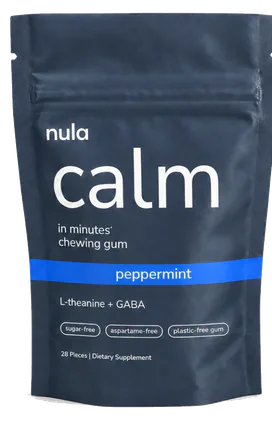
Nula Calm Gum
100 mg L-theanine + 50 mg GABA in every piece. caffeine-free. chew 1–2 pieces for at least three minutes.
shop calm