Your phone buzzes with news you didn't want. An argument just ended and your chest is still tight. Your heart is racing and you can't even explain why. Maybe stress hit out of nowhere — a work deadline, a difficult conversation, a moment where everything felt like too much at once. You need to come back down. Right now.
You don't have 20 minutes to sit with a meditation app. You don't have a quiet room or a yoga mat or a therapist on speed dial. You have maybe 60 seconds and whatever tools you can use without anyone noticing. That's the reality of needing to calm down fast — it happens in hallways, in parked cars, in bathrooms at work, and in the middle of ordinary days that suddenly stopped feeling ordinary.
This guide is built for that window. Short techniques, real science, no setup required.
Why Your Body Reacts Before Your Mind Can Catch Up
When stress hits, your body doesn't wait for your permission. Your autonomic nervous system — the part of your nervous system that runs on autopilot — detects a perceived threat and shifts into sympathetic activation, commonly called fight-or-flight mode. This happens faster than conscious thought. Your amygdala fires the alarm, and your body responds before your rational brain has a chance to evaluate whether the threat is real.
That's why stress often feels physical before it feels emotional. You notice your body first, then realize you're anxious.
Here's what sympathetic activation looks like:
-
Rapid heartbeat — adrenaline increases your heart rate to prepare for physical action
-
Shallow, fast breathing — your body prioritizes oxygen delivery over calm, measured breaths
-
Muscle tension — especially in the jaw, shoulders, and hands
-
Racing thoughts — your brain scans for threats and solutions simultaneously, creating mental noise
-
Tunnel vision — your attentional field narrows, making it harder to see the bigger picture
This response evolved to help you survive physical danger. The problem is that modern stressors — emails, arguments, bad news, deadlines — trigger the same system without giving you anything to run from.
Here's the key insight: you don't need to fully relax to regain control. You just need to shift your nervous system enough to think clearly, speak steadily, and choose what to do next. That's a much lower bar — and it's reachable in under a minute.
7 Ways to Calm Down Fast
These techniques are designed for the real world. No quiet room. No 10-minute setup. Each one works in a tight window and can be done without anyone noticing.
1. Extended Exhale Breathing (The Fastest Reset)
This is the single most effective way to calm down fast with no tools and no setup.
How to do it:
-
Inhale through your nose for 3-4 seconds
-
Exhale slowly through your mouth for 6-8 seconds
-
Repeat for 5-6 breath cycles (about 30 seconds total)
-
Focus on making the exhale at least twice as long as the inhale
Why it works: Longer exhales activate your vagus nerve, which triggers your parasympathetic nervous system — the "rest and digest" counterpart to fight-or-flight. Research from Stanford University's Huberman Lab has shown that this pattern, sometimes called a "physiological sigh," is one of the fastest real-time stress interventions available. A 2023 study published in Cell Reports Medicine found that cyclic sighing (extended exhale breathing) was more effective at reducing stress than mindfulness meditation over the same time period.
Where you can do it: Anywhere. At your desk, in your car, in a bathroom stall, walking down a hallway. Nobody can tell you're doing it.
2. Cold Water on Your Wrists or Face
A fast sensory interrupt that shifts your nervous system through physical input.
How to do it:
-
Run cold water over the insides of your wrists for 15-20 seconds
-
Alternatively, splash cold water on your face or hold a cold object (water bottle, ice cube) against the back of your neck
-
Focus on the sensation of the cold as it registers
Why it works: Cold exposure activates the mammalian dive reflex, a physiological response that slows your heart rate and redirects blood flow. Even brief cold contact on the wrists — where blood vessels sit close to the surface — can lower your heart rate measurably within seconds.
Where you can do it: Any bathroom, break room, or kitchen. Keep a cold water bottle at your desk as a ready-made reset tool.
3. 5-4-3-2-1 Grounding
A sensory-based technique that pulls your attention out of spiraling thoughts and into the present moment.
How to do it:
-
Notice 5 things you can see (the edge of your desk, a light on the ceiling, a pen, your hands, a window)
-
Notice 4 things you can touch (the chair under you, your feet on the floor, fabric on your arm, the temperature of the air)
-
Notice 3 things you can hear (keyboard clicks, air conditioning, a voice down the hall)
-
Notice 2 things you can smell (coffee, paper, hand soap)
-
Notice 1 thing you can taste (toothpaste, water, the inside of your mouth)
Why it works: Anxiety is almost always future-focused — your brain runs simulations of what could go wrong. Sensory grounding forces your attention into the present moment by giving your brain concrete, immediate data to process. This interrupts the threat-scanning loop and reduces activity in the amygdala, your brain's alarm center. Grounding techniques are widely used in clinical settings for anxiety and PTSD management, and they translate well to everyday high-stress moments.
Where you can do it: Anywhere, silently. At your desk, in a meeting, on a plane, in a car. It's entirely internal — no one knows you're doing it.
4. Shoulder Drop and Jaw Release
A physical release that targets the two areas where stress tension collects most.
How to do it:
-
Lift your shoulders up toward your ears — hold for 3 seconds
-
Let them drop completely, like they're falling off a shelf
-
Open your mouth wide, then close it gently
-
Unclench your back teeth and let your tongue rest flat on the bottom of your mouth
-
Repeat the shoulder drop once more
Why it works: Your body and brain run a feedback loop. Muscle tension signals threat. Muscle release signals safety. When you deliberately relax your shoulders and jaw — the two most common tension-holding areas during stress — you send a direct signal to your nervous system that the acute threat has passed. Research on progressive muscle relaxation has shown that even a single tension-and-release cycle can produce measurable reductions in cortisol and heart rate.
Where you can do it: At your desk, in your car, standing in line, sitting in a waiting room. The jaw release is invisible to anyone watching.
5. Bilateral Tapping
A self-administered technique borrowed from EMDR therapy that helps regulate emotional intensity.
How to do it:
-
Cross your arms over your chest, placing each hand on the opposite shoulder (the "butterfly hug" position)
-
Alternate tapping your right and left shoulder at a slow, steady pace — about one tap per second
-
Continue for 20-30 seconds while breathing normally
-
Alternatively, tap alternating knees or thighs if crossing your arms isn't practical
Why it works: Bilateral stimulation — rhythmic left-right alternation — is a core component of EMDR (Eye Movement Desensitization and Reprocessing), a therapy modality recognized by the American Psychological Association. While the full therapeutic protocol requires a trained clinician, the bilateral tapping component on its own has been shown to reduce subjective distress and lower physiological arousal. The alternating rhythm appears to engage both hemispheres of the brain, which may help interrupt the single-track stress loop.
Where you can do it: In a bathroom, in your car, at your desk (using the knee-tap variation). The butterfly hug is discreet enough for a private moment; the knee tap works when others are nearby.
6. Name What You Feel (Affect Labeling)
Putting a name on the emotion you're experiencing — even silently — reduces its intensity.
How to do it:
-
Pause and ask yourself: "What exactly am I feeling right now?"
-
Name it specifically: not "bad" but "frustrated," "overwhelmed," "scared," "angry," "embarrassed"
-
Say it silently to yourself: "I'm feeling anxious because..." or simply "This is panic"
-
You don't need to fix the feeling. Just name it.
Why it works: Neuroscience research from UCLA by Dr. Matthew Lieberman has shown that affect labeling — the act of putting feelings into words — reduces activity in the amygdala and increases activity in the prefrontal cortex. In other words, naming an emotion shifts brain activity from the alarm center to the reasoning center. This doesn't eliminate the feeling, but it moves you from reacting to observing, which gives you enough space to choose your next step.
Where you can do it: Anywhere, entirely in your head. No one needs to know you're doing it. Works during conversations, in meetings, while driving, or lying awake at night.
7. Move Your Body for 30 Seconds
When your nervous system is flooded with fight-or-flight energy, sometimes the most direct path to calm is giving the body something physical to do.
How to do it:
-
Walk briskly for 30 seconds — down a hallway, around a room, to the end of a parking lot and back
-
If walking isn't an option: do 10 standing squats, 10 wall push-ups, or shake your hands and arms vigorously for 15 seconds
-
If seated: press your palms together hard for 10 seconds, then release. Press your feet firmly into the floor and hold for 10 seconds, then release.
Why it works: Fight-or-flight prepares your body for physical action. When you move — even briefly — you complete the stress cycle your body was preparing for. This clears adrenaline and cortisol more efficiently than trying to sit still and will yourself calm. Research on exercise and anxiety consistently shows that even very short bursts of physical activity reduce anxiety and improve mood, with effects that begin within minutes.
Where you can do it: A hallway, a stairwell, a bathroom, a parking lot. The seated variations work at a desk or in a car. Even pressing your feet into the floor counts.
The 60-Second Reset Routine
Need one simple sequence you can repeat anywhere? This is the stripped-down version — four steps, 60 seconds total.
| Step | Action | Time |
| 1 | Extended exhale — inhale 4 seconds, exhale 8 seconds, repeat 3 times | 30 sec |
| 2 | Shoulder drop — lift toward your ears, let them fall completely | 5 sec |
| 3 | Name it — silently label what you're feeling ("This is anxiety") | 10 sec |
| 4 | One next action — identify one small, concrete thing you can do right now | 15 sec |
This sequence works because it addresses the three channels stress operates through: body (breathing and muscles), emotion (labeling), and cognition (choosing a next step). You don't need all seven techniques. You need one reliable sequence you can reach for without thinking.
Why Speed Matters
Stress operates in tight windows. The longer you stay in sympathetic activation, the harder it is to come back down. Your body releases more cortisol, your thoughts spiral further, and the emotional intensity compounds. What started as a manageable spike becomes a sustained state.
Fast intervention prevents the spiral. When you catch the stress response within the first 30-60 seconds and introduce even a small parasympathetic shift — a longer exhale, a physical release, a cognitive reframe — you interrupt the escalation before it builds momentum.
This is why "just wait it out" is poor advice for acute stress. The neurochemistry works against you the longer you wait. A 30-second intervention in the first minute is more effective than a 10-minute intervention after the spiral has fully developed. The best time to calm down is before you think you need to.
When You Need to Calm Down Fast
Stress doesn't schedule itself. Here are the moments when these techniques matter most:
-
Before meetings or presentations — when pre-meeting nerves or presentation anxiety spike in the final minutes
-
After arguments or confrontations — when your body is still activated even though the conversation ended
-
During travel — flights, traffic, delays, crowded spaces
-
After receiving bad news — when you need to process but also need to keep functioning
-
During panic moments — sudden onset anxiety or the feeling that something is very wrong
-
Before work deadlines — when time pressure triggers physical stress responses
-
In parenting stress — when a child's behavior pushes you to your limit and you need to respond, not react
-
Before medical appointments — when anticipatory anxiety about procedures or results builds
The common thread: you need to function before you have time to fully process. These techniques give you enough regulation to act clearly, even when the stress hasn't fully resolved.
Some people keep a fast-acting reset tool within reach for moments like this — something they can use at a desk, in a car, or before walking into a room. Not a replacement for the techniques above, but a physical anchor that makes the reset feel more automatic.
Frequently Asked Questions
What is the fastest way to calm down?
Extended exhale breathing is the fastest evidence-based method. Inhale for 3-4 seconds and exhale for 6-8 seconds, repeating for 5-6 cycles. This activates your vagus nerve and shifts your autonomic nervous system from sympathetic (fight-or-flight) to parasympathetic (rest-and-digest) dominance. Most people feel a noticeable shift within 30 seconds. For stronger effect, pair it with a shoulder drop and jaw release.
How do I calm down from anxiety fast?
Start with your breath — extend your exhale to twice the length of your inhale. Then name what you're feeling ("This is anxiety" or "I'm feeling overwhelmed"). Naming the emotion reduces amygdala activity and brings your prefrontal cortex back online. Finally, identify one small next action you can take. This three-step sequence — breathe, name, act — interrupts the anxiety loop and gives your brain something concrete to do instead of spiraling.
Why can't I calm down even when I try?
If calming techniques don't seem to work, a few things may be happening. First, you may be trying too hard to relax, which creates a secondary layer of frustration ("Why isn't this working?"). The goal isn't total calm — it's shifting enough to think clearly. Second, you may be using techniques that need more time than you have (meditation, journaling). Try faster interventions like extended exhale breathing or cold water on your wrists. Third, if stress feels persistent and unresponsive to any technique, it may be worth exploring whether generalized anxiety or another condition is involved. A mental health professional can help distinguish situational stress from something that needs clinical support.
Does cold water actually help with anxiety?
Yes. Cold water applied to the wrists, face, or back of the neck activates the mammalian dive reflex, a physiological response that slows your heart rate and stimulates the vagus nerve. This produces a rapid parasympathetic shift — essentially the opposite of fight-or-flight. It's not a long-term anxiety treatment, but as an acute intervention for moments of high activation, it's one of the fastest physical resets available.
How do I stop a panic spiral?
Panic spirals build momentum through a feedback loop: physical symptoms create fear, which intensifies the symptoms, which creates more fear. To break the loop, interrupt at the physical level first. Extended exhale breathing is the most direct tool — it forces your heart rate down even if your mind is still racing. Then use 5-4-3-2-1 grounding to pull your attention into the present moment and out of the catastrophic future your brain is projecting. Finally, name what's happening: "This is a panic response. It's uncomfortable, but it's not dangerous. It will pass." Labeling reduces the emotional intensity by shifting brain activity from the amygdala to the prefrontal cortex.
Can you train yourself to calm down faster?
Yes. Like any skill, nervous system regulation improves with practice. People who regularly practice extended exhale breathing or grounding techniques outside of stressful moments develop faster access to those techniques when stress actually hits. This is the principle behind stress inoculation — training your parasympathetic response so it activates more quickly and reliably. You don't need a daily meditation habit. Even practicing your 60-second reset a few times a week builds the neural pathway so it becomes more automatic during high-stress moments.
Key Takeaway
Longer exhale. Shoulders drop. Name it. Next step.
You don't need to feel perfectly calm. You need to feel clear enough — clear enough to speak, to choose, to act, to move forward. That's the difference between being overwhelmed and being in control, and it's reachable in 60 seconds.
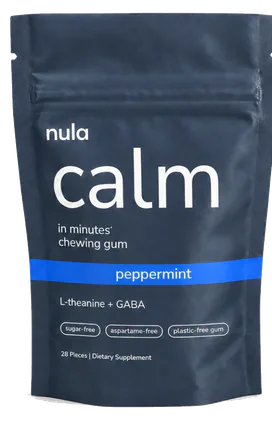
Nula Calm Gum
100 mg L-theanine + 50 mg GABA in every piece. caffeine-free. chew 1–2 pieces for at least three minutes.
shop calm