You're next. The person before you is wrapping up their last sentence. The room is full — more full than you expected. Your notes are in your hand but the words blur together. Your mouth is dry. Your heart has migrated from your chest to somewhere behind your throat. You can feel it in your ears.
It doesn't matter whether it's a wedding toast in front of 80 people, a conference talk with a timer counting down, a class presentation you've been dreading for two weeks, or a team all-hands where your manager just said your name. The seconds before you speak feel like standing at the edge of a cliff and being told the only way forward is to step off.
This is the moment. And there are things you can do right now — in the next 60 to 90 seconds — to land it.
Why Public Speaking Triggers Such an Intense Response
Glossophobia — the fear of public speaking — is the most common phobia in the world. In surveys, it consistently ranks ahead of heights, spiders, enclosed spaces, and even death. Jerry Seinfeld once joked that at a funeral, most people would rather be in the casket than giving the eulogy. The joke lands because it's barely an exaggeration.
Your brain reads a room full of eyes the same way it reads a threat-assessment panel. Dozens of faces turned toward you, evaluating, judging, waiting. Your autonomic nervous system doesn't distinguish between social evaluation and physical danger. It detects a threat and shifts into sympathetic activation — the fight-or-flight response — before your conscious mind has any say in the matter.
According to the National Institute of Mental Health, social phobias affect an estimated 12.1% of U.S. adults at some point in their lives, with fear of public speaking being the most frequently reported trigger. The physical response is not a sign of weakness. It is a deeply wired survival mechanism firing in the wrong context.
Here's what that looks like in real time:
-
Dry mouth — saliva production decreases under sympathetic activation
-
Trembling hands — fine motor control is sacrificed for gross motor readiness
-
Voice shake — tension in the throat and diaphragm disrupts vocal stability
-
Racing heart — adrenaline increases heart rate to prepare for physical action
-
Blank mind — working memory narrows as the brain prioritizes threat scanning
-
Tunnel vision — your visual field contracts, making the audience feel overwhelming
-
Urge to flee — the most fundamental fight-or-flight impulse
Here's the key insight: the fear response peaks right before you start speaking. Research from Stanford's communication program and clinical anxiety studies consistently show that once you begin speaking, the intensity of the response typically starts to decrease within the first 30 to 60 seconds. The worst part is the anticipation, not the performance. Everything that follows is designed to get you through that peak.
6 Ways to Calm Down Before Public Speaking
These techniques are designed for the real window before you speak. Not an hour before. Not the night before. For the 30 seconds to 2 minutes between "you're up next" and walking to the front of the room.
1. Extended Exhale Breathing (With a Spoken Sentence)
This is the single most effective way to calm your nervous system before speaking, and it doubles as a vocal warm-up.
How to do it:
-
Inhale through your nose for 4 seconds
-
Exhale slowly through your mouth for 6 seconds
-
After the exhale, say one sentence out loud at a deliberately slow pace
-
Repeat for 3 to 5 breath cycles (about 40-45 seconds total)
The sentence can be your opening line, a neutral phrase, or even just counting slowly. The point is to bridge the breathing into speech rhythm.
Why it works: Longer exhales activate your vagus nerve, which triggers your parasympathetic nervous system and directly counteracts fight-or-flight. Research from Stanford's Huberman Lab has shown that this pattern — sometimes called a "physiological sigh" — is one of the fastest real-time stress interventions available. A 2023 study published in Cell Reports Medicine found that cyclic sighing (extended exhale breathing) was more effective at reducing physiological stress markers than mindfulness meditation over the same time period. Adding the spoken sentence after each exhale trains your voice to match the slower rhythm, so when you begin your speech, the cadence carries over.
2. Jaw and Tongue Release
Tension collects in the jaw, tongue, and throat before speaking. This is where voice shake originates — not in your lungs, but in the muscles surrounding your vocal cords.
How to do it:
-
Open your mouth as wide as you comfortably can, hold for 2 seconds, then close gently
-
Let your tongue sit flat and loose on the bottom of your mouth
-
Unclench your back teeth — create a small gap between your upper and lower molars
-
Hum quietly for 3 to 5 seconds, feeling the vibration in your chest and throat
Why it works: Matt Abrahams at Stanford recommends vocal warm-ups before speaking to reduce voice tension. The jaw release is a simpler, faster version of the same principle. When the muscles around your vocal cords relax, your voice drops into its natural register — fuller, steadier, and more authoritative. The hum also warms up your vocal cords so your first words don't come out thin or cracked.
3. Power Stance for 30 Seconds
Your posture communicates to your brain, not just to your audience. Fidgeting, hunching, and crossed arms feed back into your nervous system, signaling threat. Stillness and grounded posture signal safety.
How to do it:
-
Plant both feet flat on the floor, shoulder-width apart
-
Distribute your weight evenly between both legs
-
Pull your shoulders back and down — not stiff, just open
-
Let your arms hang naturally at your sides or rest your hands on a surface in front of you
-
Hold this position for 30 seconds before you walk up
Why it works: Research on embodied cognition shows that your posture influences your emotional state, not just the other way around. When your body is stable and grounded, your brain reads "no immediate threat." This doesn't eliminate nervousness, but it lowers the baseline intensity. Planting your feet also prevents the visible signs of anxiety — swaying, shifting weight, pacing — that audiences interpret as uncertainty and that reinforce your own stress response through the feedback loop.
4. Slow Your Opening — 50% Slower Than Feels Natural
Speed is the first thing that breaks under adrenaline. Your body wants to rush through the perceived threat. If you don't override that instinct before your first word, your opening will be too fast, your breath will get shallow, and you'll spend the rest of the speech trying to recover a pace you never set.
How to do it:
-
Before you begin, make a conscious decision: "I will speak 50% slower than feels natural for the first 60 seconds."
-
Don't try to slow down mid-speech. Set the pace before your mouth opens.
-
Pause after your first sentence. Let the room settle. Then continue.
Why it works: When you're under adrenaline, your internal speedometer is miscalibrated. What feels "normal" to you sounds rushed to the audience. Deliberately choosing a slower start compensates for that gap. Audiences perceive slower opening pacing as confidence and authority. Rushed pacing reads as nerves. Your first 60 seconds set the rhythm for everything that follows — get those right, and the rest tends to fall into place.
5. Find Three Friendly Faces
A room full of strangers feels like a wall of judgment. Your brain scans for threats and finds ambiguity everywhere — blank expressions, crossed arms, people looking at their phones. Anchoring to specific friendly faces breaks the pattern.
How to do it:
-
Before you begin (or during your first few sentences), scan the room for three people who look receptive — nodding, smiling, leaning forward, making eye contact
-
Speak to those three people. Rotate your gaze among them.
-
As you settle in, gradually expand to include more of the room
Why it works: Social threat perception is driven by ambiguity. When your brain can't read the crowd, it defaults to worst-case interpretation. Anchoring to three specific friendly faces gives your brain clear positive social signals, which reduces the intensity of the threat response. It also gives you natural eye-contact targets, which makes your delivery look more confident and connected — even if you're only looking at three people.
6. Reframe: "I'm Sharing, Not Performing"
The internal framing of public speaking changes everything. "Performing" implies judgment, execution, and the possibility of failure. "Sharing" implies conversation, contribution, and connection. The physiological response to each framing is measurably different.
How to do it:
-
Before you walk up, say to yourself: "I'm sharing something I know with people who want to hear it."
-
Drop the performer mindset. You're not being graded. You're transferring information or telling a story.
-
If the reframe feels forced, try a simpler version: "I know this material. I'm just talking about it."
Why it works: Research from Harvard Business School on anxiety reappraisal has shown that how you frame a stressful experience changes how your body responds to it. Reframing public speaking as sharing rather than performing reduces the evaluative pressure your brain assigns to the moment. This lowers cortisol output and reduces the intensity of the sympathetic response. You're not trying to trick yourself into feeling calm. You're giving your brain a more accurate interpretation of what's actually happening: you're talking to people about something you know.
The 60-90 Second Reset Routine
If you only have a minute before your name is called, run through this sequence. It covers breath, body, and pacing in the tightest possible window.
| Step | Action | Time |
| 1 | Extended exhale with one spoken sentence — inhale 4 sec, exhale 6 sec, say your opening line slowly. Repeat 3 times. | 45 sec |
| 2 | Jaw release and hum — open wide, close gently, hum for 3-5 seconds | 10 sec |
| 3 | Plant feet, set stance — feet flat, shoulders back and down, weight even | 10 sec |
| 4 | Commit: "Slower than natural for 60 seconds" — set the pacing intention before your first word | 5 sec |
Total: roughly 70 seconds. This sequence works because it addresses the three things that break first under adrenaline: breath, voice, and speed. You don't need all six techniques from above. You need one reliable routine you can reach for without thinking.
Why Speed Matters
The window before speaking is measured in seconds, not minutes. You rarely get 20 minutes to meditate. You don't have time for a full warm-up routine, a journaling session, or a long walk. You have the gap between "you're up next" and walking to the front of the room.
That's why every technique in this guide is built for that window. Extended exhale breathing works in 45 seconds. A jaw release takes 10. Planting your feet is instant. The pacing decision is a single thought you set before you open your mouth.
The nervous system responds to fast, targeted interventions. A 60-second routine executed in the right window is more effective than 30 minutes of general relaxation done hours before. The goal is not to feel calm. The goal is to feel steady enough to deliver your first few sentences clearly. Once you start — and once you hear your own voice sounding controlled — the fear response begins to fade on its own.
When Public Speaking Anxiety Strikes
Public speaking anxiety doesn't only happen on big stages. It shows up in everyday professional and personal situations where you're expected to speak in front of others:
-
Conference talks and keynotes — large audiences, bright lights, formal settings
-
Wedding toasts and eulogies — emotional stakes on top of performance pressure
-
Class presentations — peer judgment in an academic setting
-
Team meetings — being called on to give an update or share a report
-
Company all-hands — speaking to an entire organization
-
Pitch meetings — high-stakes business presentations with real consequences
-
Award acceptances — unexpected spotlight with no preparation time
-
Panel discussions — unpredictable questions in front of a live audience
-
Open mic nights — voluntary vulnerability in front of strangers
The techniques above work the same way regardless of the setting. The physiological response to speaking in front of 10 coworkers and speaking in front of 500 strangers is driven by the same nervous system pathway. The scale changes, but the reset doesn't.
If your anxiety is specific to presentations at work, you may also find these guides useful: how to calm nerves before a meeting and how to calm down before a presentation.
Before speaking, choose a practical cue you can keep nearby: your opening sentence on a card, a glass of water, or a reminder to pause. The point is to make your next step familiar, not to promise an immediate change in how you feel.
Frequently Asked Questions
What is the fastest way to calm down before a speech?
Extended exhale breathing is the fastest evidence-based method. Inhale for 4 seconds and exhale for 6 seconds, repeating for 3 to 5 cycles. This activates your vagus nerve and shifts your nervous system out of fight-or-flight mode in under 60 seconds. Adding a slow spoken sentence after each exhale serves double duty: it calms your system and warms up your voice at the same time. Pair it with a jaw release and a grounded stance for the full reset.
Why does public speaking cause so much fear?
Public speaking triggers your brain's threat-detection system because it combines several primal stressors: social evaluation, visibility, inability to flee, and performance pressure. Your autonomic nervous system reads a room of watching eyes as a judgment panel and activates the same fight-or-flight response it would use for physical danger. Glossophobia is the most common phobia globally because these social-evaluation circuits are deeply wired — they evolved in environments where group rejection had survival consequences.
How do I stop my voice from shaking during a speech?
Voice shaking comes from tension in the jaw, throat, and diaphragm — not from a lack of confidence. To counter it: release your jaw by opening your mouth wide once and closing gently. Let your tongue rest flat and loose. Hum for a few seconds to warm up your vocal cords. Then take 3 to 5 breath cycles with extended exhales. Speaking your first sentence out loud before you begin — even quietly to yourself — helps your voice settle into a steadier rhythm before the audience hears you.
Is fear of public speaking the most common phobia?
Yes. In most large-scale surveys, fear of public speaking (glossophobia) ranks as the number one phobia, ahead of heights, enclosed spaces, spiders, and death. The National Institute of Mental Health reports that social phobias — of which public speaking fear is the most common subtype — affect an estimated 12.1% of U.S. adults at some point in their lives. Informal surveys often show even higher numbers, with some estimates suggesting that 73% or more of people experience at least some degree of speech anxiety.
How do I stop blanking out during a speech?
Blanking out happens because adrenaline narrows your working memory. Your brain shifts resources away from recall and toward threat detection. To counter it: slow your opening pace deliberately. Pausing after your first sentence gives your brain time to catch up. Keep brief notes or bullet points visible — not a full script, but anchor words that trigger the next section. If you do blank, pause, take one extended exhale, glance at your notes, and continue. Audiences read a deliberate pause as confidence, not failure. The blank usually lasts 2 to 3 seconds, even though it feels like an eternity.
Can you get over public speaking anxiety?
Most people don't eliminate public speaking anxiety entirely — and they don't need to. The goal is to reduce it to a manageable level where it doesn't control your delivery. Repeated exposure is the most effective long-term strategy: the more you speak in front of groups, the more your brain recalibrates the threat level downward. Pairing exposure with fast-reset techniques builds a reliable pattern where nerves show up but don't take over. For severe or persistent anxiety that causes avoidance, cancellations, or panic attacks, cognitive behavioral therapy (CBT) has strong evidence for treating social anxiety disorder and specific phobias. A mental health professional can help determine whether your experience falls within the normal range or would benefit from clinical support.
Key Takeaway
Longer exhale. Jaw loose. Feet planted. Start slower than feels right.
The fear of public speaking peaks in the seconds before you begin — not during the speech itself. Once you start and hear your own voice sounding steady, the intensity drops. Everything in this guide is built to get you through that peak. Ninety seconds of intentional reset can be the difference between a shaky start and a grounded one.
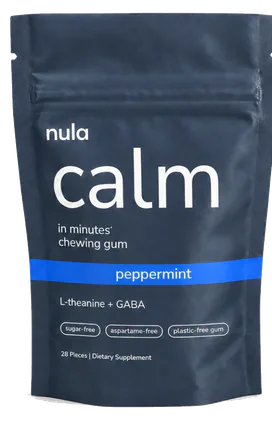
Nula Calm Gum
100 mg L-theanine + 50 mg GABA in every piece. caffeine-free. chew 1–2 pieces for at least three minutes.
shop calm