You are sitting in your car in the parking lot. The interview starts in twelve minutes. Your hands are damp against the steering wheel. Your mind is cycling through the same three answers you rehearsed last night, except now none of them sound right. Your chest feels tight. You check the mirror, adjust your collar, and wonder if the interviewer will notice that your voice is about to shake.
This is one of the most common moments in professional life, and almost nobody talks about what to actually do when it is happening. Not the night before. Not in a general sense. Right now, in the car, in the lobby, in the hallway outside the conference room. This guide is about calming your nerves before an interview in the minutes you actually have — fast, quiet, and without anyone noticing.
Why Do You Get So Nervous Before an Interview?
The nervousness you feel before an interview is not a personal failing. It is your nervous system doing exactly what it was designed to do. When your brain perceives a high-stakes social evaluation — which is precisely what an interview is — it activates the sympathetic branch of your autonomic nervous system. This is the same fight-or-flight response that helped our ancestors survive genuine physical threats.
The problem is that your body cannot tell the difference between a job interview and a predator. The cascade is automatic and fast. Adrenaline and cortisol flood your system, and within seconds you experience a constellation of symptoms that feel overwhelming but are entirely predictable:
-
Increased heart rate — your heart pounds or races, sometimes visibly
-
Shallow, rapid breathing — breaths move into the upper chest, reducing oxygen flow to the brain
-
Sweaty palms and underarms — your body's cooling system activates preemptively
-
Tense muscles — especially in the shoulders, jaw, and hands
-
Mental fog or racing thoughts — working memory narrows, making it harder to recall prepared answers
-
Dry mouth or tight throat — blood flow shifts away from the digestive system
-
Restless legs or fidgeting — excess energy with no physical outlet
According to the National Institute of Mental Health, anxiety disorders affect over 19% of U.S. adults in any given year. But you do not need a clinical diagnosis to experience intense pre-interview nerves. The response is universal. Understanding that this is biology, not weakness, is the first step toward managing it.
5 Techniques to Calm Your Nerves Before an Interview (Fast)
Each of the following techniques is designed for the real conditions of an interview: limited time, limited privacy, and no equipment. They are ordered by speed and ease of use.
1. Extended Exhale Breathing (The Physiological Sigh)
How to do it:
-
Inhale through your nose for 4 seconds
-
Take one additional short "sip" of air in through your nose (about 1 second)
-
Exhale slowly through your mouth for 6-8 seconds
-
Repeat for 3-5 cycles
Why it works:
This technique, highlighted by neuroscientist Andrew Huberman on the Huberman Lab podcast, directly activates the parasympathetic nervous system. The extended exhale stimulates the vagus nerve, which sends a signal to your brain to lower heart rate and reduce cortisol output. The double inhale maximally inflates the tiny air sacs in your lungs (alveoli), which makes the long exhale even more effective at offloading carbon dioxide and calming the body. A single physiological sigh can reduce heart rate within one breath cycle. This is the single fastest voluntary tool for nervous system regulation that exists.
When to use it: In the car before walking in. In a restroom stall. While waiting in a lobby chair. It is completely silent and invisible to others.
2. Shoulder Drop and Tension Release
How to do it:
-
Squeeze your shoulders up toward your ears as hard as you can
-
Hold the squeeze for 5 seconds
-
Release all at once and let your shoulders fall
-
Let your hands go limp in your lap
-
Repeat once or twice
Why it works:
This is a simplified version of progressive muscle relaxation, a technique with decades of clinical research supporting its effectiveness for acute anxiety. When you are nervous, your body holds tension unconsciously — particularly in the trapezius muscles across your shoulders and upper back. By deliberately tensing and then releasing, you create a contrast that your nervous system interprets as safety. The release triggers a small parasympathetic response: muscles soften, breathing slows, and the mental grip of anxiety loosens. It also resets your posture, which feeds back into how confident you feel and sound.
When to use it: Sitting in a waiting room chair. At your desk before a video call. Even standing in a hallway — the movement is small enough that nobody will notice.
3. Cognitive Reframing (Rename the Feeling)
How to do it:
-
Notice the physical sensations you are experiencing (racing heart, tight chest, buzzy energy)
-
Say to yourself, silently or aloud: "This is excitement. My body is getting ready to perform."
-
Do not try to make the sensations go away — just relabel them
Why it works:
Research from Harvard Business School, published by Alison Wood Brooks, found that people who reframed anxiety as excitement performed significantly better in high-pressure tasks than those who tried to calm down. The reason is counterintuitive: anxiety and excitement are nearly identical in the body. Both involve elevated heart rate, adrenaline, and heightened alertness. The difference is the story your mind tells about those sensations. Trying to force calm from a state of high arousal is difficult. Shifting the label from "I am terrified" to "I am ready" is much easier and measurably more effective.
When to use it: The moment you notice your inner monologue turning negative. In the car, in the elevator, walking down the hall. This technique is entirely mental and takes less than 10 seconds.
4. The 5-4-3-2-1 Grounding Technique
How to do it:
-
Identify 5 things you can see (the ceiling tiles, the receptionist's desk, the color of the wall)
-
Identify 4 things you can touch (the fabric of your pants, the armrest, the cool air)
-
Identify 3 things you can hear (the hum of the HVAC, a phone ringing, footsteps)
-
Identify 2 things you can smell (coffee, the carpet, your own cologne)
-
Identify 1 thing you can taste (the mint you just had, water, nothing specific)
Why it works:
Anxiety pulls your attention into the future — into imagined failure, stumbled answers, and worst-case outcomes. Grounding forces your brain back into the present moment by engaging all five senses. This is a well-established technique in cognitive behavioral therapy and is recommended by therapists for panic attacks, generalized anxiety, and acute stress episodes. It works because sensory input competes with anxious thought loops for processing bandwidth in the prefrontal cortex. The more senses you engage, the less room there is for catastrophic thinking.
When to use it: While sitting in a waiting room or lobby. This is especially useful if your mind is spiraling and you cannot concentrate. The exercise takes about 30-60 seconds.
5. Focus Narrowing (One Sentence, One Goal)
How to do it:
-
Instead of trying to remember your entire preparation, pick one sentence you want to say clearly in your opening answer
-
Rehearse that single sentence in your mind — slowly, as if you are actually speaking
-
Let everything else go for now
-
Tell yourself: "I just need to land the first answer. The rest will follow."
Why it works:
Under stress, your working memory contracts. Trying to hold seven talking points, three stories, and a list of questions simultaneously is a recipe for overwhelm. Narrowing your focus to a single deliverable reduces cognitive load dramatically. It gives your brain one clear instruction rather than a dozen competing ones. And practically, once you deliver that first answer well, momentum takes over. Your confidence rebuilds in real time, and the rest of the interview flows more naturally.
When to use it: In the final 2-3 minutes before you walk in or the call begins. In the parking lot. While the receptionist is letting the interviewer know you have arrived. This is your last mental action before showtime.
6. Posture Anchoring
How to do it:
-
Place both feet flat on the floor, hip-width apart
-
Sit or stand with your spine straight but not rigid
-
Rest your hands on your thighs or the table — open, not clenched
-
Drop your chin slightly so it is level, not lifted
-
Take one slow breath in this position
Why it works:
Research on embodied cognition shows that your posture directly influences your emotional state. A collapsed, hunched posture feeds back into the nervous system as a signal of defeat or fear. An open, grounded posture signals stability. This is not about "power posing" — it is about removing the physical cues that amplify anxiety. When your body is organized and still, your mind receives fewer alarm signals. You also project composure to the interviewer, which creates a positive feedback loop: they respond to you as someone who is calm, which reinforces your own sense of calm.
When to use it: The moment you sit down in the interview room or at your desk for a video call. Also useful in the waiting room to set a baseline of physical stability.
The 60-Second Reset Routine
If you only have one minute, use this sequence. It combines the most effective elements from the techniques above into a single repeatable routine.
| Step | Action | Time |
| 1 | Extended exhale — Double inhale through the nose, long exhale through the mouth. Repeat 3 times. | 30 seconds |
| 2 | Shoulder drop — Squeeze shoulders to ears, hold 5 seconds, release completely. | 10 seconds |
| 3 | Narrow focus — Choose one sentence for your opening answer. Say it silently. | 10 seconds |
| 4 | One small action — Stand up, straighten your jacket, take a sip of water. Move forward. | 10 seconds |
This routine works in a car, a restroom, a waiting room, or at a desk. Repeat it as many times as you need. Each cycle takes about 60 seconds and compounds — the second round is calmer than the first.
Why Speed Matters for Interview Anxiety
Pre-interview nerves do not build over hours. They spike in short, intense windows — the drive over, the moment you park, the minutes in the waiting room, the walk to the conference room. You rarely have 20 minutes for a meditation session or a long journaling exercise. You have 60 seconds, maybe 90.
That is why fast-acting tools matter. The techniques in this guide are designed for exactly those compressed moments. They are not a replacement for deeper preparation or long-term anxiety management, but they fill a critical gap: the space between knowing your material and being physically able to deliver it.
Think of them as moment-specific tools. You would not use a sledgehammer to hang a picture frame. You need the right tool for the right window, and the window before an interview is narrow.
Real-Life Scenarios Where Interview Anxiety Shows Up
Interview anxiety is not limited to the traditional in-person sit-down. It surfaces across a wide range of professional situations, each with its own specific pressures:
-
Phone screens — anxiety without visual cues; you cannot read the interviewer's reactions, which amplifies uncertainty
-
Video calls — the added stress of seeing yourself on camera, managing technology, and performing in your own home
-
Panel interviews — multiple evaluators at once, which can feel like an audience rather than a conversation
-
Second and final round interviews — higher stakes because you have already invested time and hope
-
Salary and offer negotiations — a different kind of nervousness rooted in self-advocacy and potential conflict
-
Waiting rooms and lobbies — the dead time before the interview where anxiety has nothing to compete with
Each of these situations benefits from the same core techniques, adapted to the context. If you also experience anxiety in other high-stakes professional settings, you may find related strategies in posts about managing anxiety before meetings and calming nerves before a presentation.
Some people keep a fast-acting reset tool nearby for moments like this — something small enough to use in a waiting room or car before walking in. If that sounds useful, it is worth exploring what works for you. Find quick-reset options here.
Frequently Asked Questions
How do I calm my nerves before a job interview quickly?
The fastest method is the physiological sigh: a double inhale through the nose followed by an extended exhale through the mouth. Neuroscience research has shown this can lower heart rate within a single breath cycle. Combine it with a shoulder tension release (squeeze and drop) and you can shift your nervous system state in under 60 seconds. The key is not eliminating nervousness entirely but reducing it enough that you can think clearly, speak steadily, and make eye contact. Focus on speed and simplicity — the techniques that work fast are the ones you will actually use in the moment.
Why do I get so nervous before interviews?
Your brain interprets a job interview as a social evaluation threat, which triggers the same fight-or-flight response as a physical danger. This is an automatic function of the autonomic nervous system and has nothing to do with how prepared you are or how qualified you are for the role. The symptoms — racing heart, sweaty palms, mental fog, tight throat — are universal human responses to perceived high-stakes judgment. Understanding this helps because it removes the layer of self-criticism ("Why can I not handle this?") that often makes the anxiety worse.
How do I stop my hands from shaking before an interview?
Shaky hands are caused by excess adrenaline with no physical outlet. Two things help immediately. First, press your palms firmly together for 5-10 seconds, then release — this burns off some of the nervous energy in your hand muscles. Second, hold something — a pen, a folder, a water bottle — which gives the tremor less range of motion and is less visible. Extended exhale breathing will also reduce the adrenaline load over 2-3 breath cycles. If you are sitting at a table, resting your hands flat on the surface provides stabilization that the interviewer will not notice.
Is it normal to feel anxious before every interview?
Yes. According to survey data, the vast majority of job candidates report some degree of anxiety before interviews, regardless of experience level. Seasoned executives, hiring managers who conduct interviews daily, and career coaches all report pre-interview nerves when they are the ones being evaluated. The frequency does not decrease automatically with experience. What changes is your relationship to the feeling — with practice, you learn to recognize it, regulate it faster, and perform well despite it. If your anxiety is severe enough to prevent you from attending interviews or causes prolonged distress, it may be worth speaking with a licensed therapist who specializes in anxiety or cognitive behavioral therapy.
What helps with pre-interview jitters?
Pre-interview jitters respond best to a combination of physical regulation and mental focus. On the physical side, extended exhale breathing and progressive muscle relaxation (even a simplified shoulder squeeze and release) directly counteract the fight-or-flight response. On the mental side, cognitive reframing (relabeling anxiety as excitement) and focus narrowing (choosing one clear opening sentence) reduce the cognitive overload that makes jitters feel unmanageable. The 60-second reset routine in this guide combines both dimensions into a fast, repeatable sequence you can use anywhere.
Can breathing exercises help with interview anxiety?
Breathing exercises are the single most evidence-supported fast intervention for acute anxiety. The reason is mechanical: extended exhales directly stimulate the vagus nerve, which is the primary communication channel between your body and your parasympathetic ("rest and digest") nervous system. This is not a metaphor or a mindfulness concept — it is a measurable physiological response. Studies referenced on the Huberman Lab podcast have demonstrated that cyclic physiological sighing (the double-inhale, long-exhale pattern) reduces cortisol levels and subjective stress more effectively than meditation in controlled trials. Three to five breath cycles is enough to produce a noticeable shift.
Key Takeaway
Longer exhale. Shoulders drop. First answer clear. That is the entire routine. You do not need to feel perfectly calm to interview well — you just need to bring your body down one notch so your preparation can do its job.
If you experience persistent, severe anxiety that interferes with daily functioning or prevents you from pursuing professional opportunities, please consult a licensed mental health professional. The techniques in this guide are intended for situational nervousness and are not a substitute for clinical treatment.
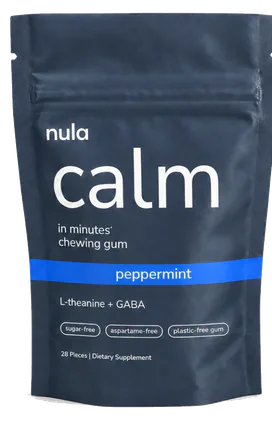
Nula Calm Gum
100 mg L-theanine + 50 mg GABA in every piece. caffeine-free. chew 1–2 pieces for at least three minutes.
shop calm