Video call anxiety is the nervous feeling before or during a call on camera: a fast heart, a tight chest, and a strong wish to keep the camera off. Research points to a few causes. You watch your own face. Other faces are close and seem to stare. And you cannot move.
The short version of what to do: hide your self-view, breathe out slowly, tell yourself "I am excited", have your first sentence ready, and turn the camera off when it is optional. Below is the research behind each step, and what that research does not show.
What is video call anxiety?
Video call anxiety, also called Zoom anxiety, is stress that is specific to calls on camera. It can show up before a work meeting, a video interview, a telehealth visit or a family call. It is a common experience, not a diagnosis.
It is close to phone call anxiety, with one large difference. On the phone, nobody can see you. On video, everybody can, and you can see yourself too.
Why video calls make you anxious: what the research says
Most of the research comes from one idea. In 2021, Stanford professor Jeremy Bailenson proposed four causes of "Zoom fatigue". His paper is an argument, not an experiment. He wrote that readers should treat the claims as arguments, not yet scientific findings. Later studies tested parts of it.
1. You watch yourself the whole time
Bailenson called this "an all day mirror". In a room, you never see your own face while you talk. On a call, it is always there.
A survey of 9,787 people by the same Stanford group found that people who felt more discomfort from seeing themselves ("mirror anxiety") also reported more fatigue after calls. Women reported more fatigue than men. A second survey of 613 adults found that people who were less happy with how their face looked reported more fatigue.
One study looked at eyes directly. In a 2017 eye-tracking study, young women with a social anxiety disorder diagnosis looked at their own image more than women without it during a video chat. More time on their own image went with more anxiety. That study had only young women, in a staged call, so it may not apply to everyone.
Self-view does not bother everybody. A 2022 study of remote employees and students found that more self-view went with worse feelings about meetings only for people who are very aware of how others see them.
2. Faces are close, and they all seem to look at you
In a meeting room, people look at the speaker, their notes or the window. On a call, every face is turned to the camera for the whole meeting, at a size the brain usually links to a very close conversation. Bailenson argued that this is intense. No experiment has directly tested this part yet.
3. The camera adds work
On camera, you have to work to send signals that are automatic in person: you nod more, you look at the lens, you keep your face in the frame.
The strongest evidence here is a four-week field experiment with 103 employees of one US company. Researchers assigned people to camera-on or camera-off weeks, then switched them. People were more tired on camera-on days. More tired people spoke up less and felt less engaged, the same day and the next day. The effect was larger for women and for newer employees. This study measured fatigue, not anxiety.
4. You cannot move
On the phone, you can pace. On camera, you stay in a small frame. Bailenson listed this reduced movement as the fourth cause. If you have read our guide to calming down before a phone call, you know that nervous energy needs somewhere to go.
5 ways to calm down before a video call
Each step says what the research supports and where the evidence stops.
1. Hide your self-view
This removes the mirror. Other people still see you. You just stop watching yourself.
Zoom (desktop): hover over your video, open the "..." menu, and select Hide Self View. Zoom's steps.
Microsoft Teams: open View, then More options, then Hide me. Microsoft's steps.
Google Meet: hover over your own picture, select More options, then Minimize. Meet makes your picture small. It does not remove it. Google's steps.
What the research says: the surveys above link discomfort with your own image to more fatigue, and the researchers suggest hiding self-view. But no published experiment has tested whether hiding it lowers anxiety. Try it for a week and judge for yourself. We read these help pages on November 20, 2026. Menu names can change.
2. Breathe out longer than you breathe in
How to do it:
Breathe in slowly through your nose.
Take a second, short breath in to fill your lungs.
Breathe out slowly through your mouth until your lungs are empty.
Repeat for one to five minutes.
For more quick techniques like this one, see how to calm down fast.
What the research says: this pattern is called cyclic sighing. In a 2023 Stanford study, 108 healthy adults did five minutes a day of a breathing exercise or mindfulness meditation for 28 days. The cyclic sighing group had a larger rise in daily positive mood than the meditation group, and a larger drop in breathing rate. Anxiety scores went down in every group, with no difference between them.
The limits: the study tested a daily habit, not a few breaths right before a stressful event. It did not measure cortisol, and it found no change in resting heart rate. So treat this as a helpful habit, not an instant switch.
3. Say "I am excited"
Most people try to calm down. In a 2014 study by Alison Wood Brooks of Harvard Business School, students who said "I am excited" out loud before a speech were rated as more persuasive, more competent and more confident than students who said "I am calm". The same idea improved scores in a karaoke task and in math tests.
The limits: the students' hearts beat just as fast. The words did not lower their anxiety. They changed what the students did with it. The same reframe is in our guides to calming down before public speaking and before a presentation. The tasks were speeches, songs and math, not video calls, and all the participants were students.
4. Write your first sentence and join two minutes early
This step is practical advice, not a study result. The first ten seconds are the hardest part of a call. Write your opening line on a note next to the camera. Then join early, so you check your sound, light and frame before anybody watches. You start the meeting with those problems already solved.
For more ways to prepare, see how to calm your nerves before a meeting. If the call is an interview, see how to calm your nerves before an interview.
5. Turn the camera off when it is optional
The camera experiment above found more fatigue on camera-on days. If your team allows it, ask to join some meetings by audio. A walking phone call also lets you move, which a camera does not.
When the camera must stay on, look at the person who is talking, not at the whole grid, and stand up between calls.
A 2-minute reset before you join
Step | Action | Time |
1 | Join early. Check sound, light and frame. | 30 sec |
2 | Hide your self-view. | 10 sec |
3 | Double breath in, long breath out. Repeat. | 60 sec |
4 | Say "I am excited". Read your first sentence. | 20 sec |
The goal is not to feel perfectly calm. The goal is to start talking.
What the research does not show
Most of these studies measured fatigue, not anxiety. The two are related, but they are not the same.
Most of them are surveys. A survey can show that two things go together. It cannot show that one causes the other.
No experiment has tested hiding self-view against anxiety.
The breathing study tested a daily habit over a month, not a rescue just before a call.
None of these studies tested a supplement or any Nula product.
When it is more than nerves
Nerves before a call are normal. If fear of being watched makes you avoid work, school or people for weeks, it may be social anxiety disorder, which is treatable. The National Institute of Mental Health explains the signs and the treatments. A licensed mental health professional can help.
For a wave of stress that is not about one call, see what to do when stress hits all at once. To learn what is in our gum, see the ingredient overview.
Frequently Asked Questions
What is the fear of video calls called?
There is no official medical name. People call it video call anxiety or Zoom anxiety. It is not a diagnosis. For some people it is part of social anxiety, which a licensed professional can assess.
Why do I get nervous on Zoom calls?
Researchers point to four features of video calls: you see your own face the whole time, other faces are close and seem to look at you, you must work harder to send and read body language, and you cannot move much. In a survey of 9,787 people, those who felt more discomfort from seeing themselves also reported more fatigue after calls.
Does hiding self-view help with video call anxiety?
It is a sensible first step, but it is not proven. Researchers who study video calls suggest it, and surveys link discomfort with your own image to more fatigue. No published experiment has yet tested whether hiding self-view lowers anxiety. One study found that people who are not self-conscious were not bothered by self-view at all.
Is it okay to turn my camera off?
Often, yes. In a four-week experiment with 103 employees, people were more tired on days with the camera on, and tired people spoke up less. If the camera is optional, you can ask to join by audio for some meetings.
Why are video calls so exhausting?
A camera adds work that a phone call or a room does not. You watch yourself, you hold eye contact with a grid of faces, and you stay in one spot. A 2021 field experiment found more fatigue on camera-on days, and the effect was larger for women and for newer employees.
Does chewing gum help before a call?
The evidence is mixed. One small lab study of 40 adults found less self-rated stress and lower cortisol while chewing gum during a stress task. Two later studies did not repeat the stress result. Chew before the call if you like it, and not while you speak.
More on the gum question: does chewing gum help with stress?
Key takeaway
Hide the mirror. Long breath out. "I am excited." First sentence ready. Join.
Sources
Bailenson JN (2021). Nonverbal overload: A theoretical argument for the causes of Zoom fatigue. Technology, Mind, and Behavior, 2(1). doi.org/10.1037/tmb0000030
Fauville G, Luo M, Queiroz ACM, Lee AY, Bailenson JN, Hancock J (2023). Video-conferencing usage dynamics and nonverbal mechanisms exacerbate Zoom Fatigue, particularly for women. Computers in Human Behavior Reports, 10:100271. doi.org/10.1016/j.chbr.2023.100271
Ratan R, Miller DB, Bailenson JN (2022). Facial appearance dissatisfaction explains differences in Zoom fatigue. Cyberpsychology, Behavior, and Social Networking, 25(2):124–129. doi.org/10.1089/cyber.2021.0112
Kuhn KM (2022). The constant mirror: Self-view and attitudes to virtual meetings. Computers in Human Behavior, 128:107110. doi.org/10.1016/j.chb.2021.107110
Vriends N, Meral Y, Bargas-Avila JA, Stadler C, Bögels SM (2017). How do I look? Self-focused attention during a video chat of women with social anxiety (disorder). Behaviour Research and Therapy, 92:77–86. doi.org/10.1016/j.brat.2017.02.008
Shockley KM, Gabriel AS, Robertson D, Rosen CC, Chawla N, Ganster ML, Ezerins ME (2021). The fatiguing effects of camera use in virtual meetings: A within-person field experiment. Journal of Applied Psychology, 106(8):1137–1155. doi.org/10.1037/apl0000948
Balban MY, Neri E, Kogon MM, Weed L, Nouriani B, Jo B, Holl G, Zeitzer JM, Spiegel D, Huberman AD (2023). Brief structured respiration practices enhance mood and reduce physiological arousal. Cell Reports Medicine, 4(1):100895. doi.org/10.1016/j.xcrm.2022.100895
Brooks AW (2014). Get excited: Reappraising pre-performance anxiety as excitement. Journal of Experimental Psychology: General, 143(3):1144–1158. doi.org/10.1037/a0035325
Scholey A, Haskell C, Robertson B, Kennedy D, Milne A, Wetherell M (2009). Chewing gum alleviates negative mood and reduces cortisol during acute laboratory psychological stress. Physiology & Behavior, 97(3–4):304–312. doi.org/10.1016/j.physbeh.2009.02.028
Torney LK, Johnson AJ, Miles C (2009). Chewing gum and impasse-induced self-reported stress. Appetite, 53(3):414–417. doi.org/10.1016/j.appet.2009.07.009
Johnson AJ, Jenks R, Miles C, Albert M, Cox M (2011). Chewing gum moderates multi-task induced shifts in stress, mood, and alertness. A re-examination. Appetite, 56(2):408–411. doi.org/10.1016/j.appet.2010.12.025
We read every source on November 20, 2026. This article is written by the Nula team. See our editorial policy.
This article is for informational purposes only and is not a substitute for professional medical or mental health advice. If your anxiety is severe, persistent, or affects your daily life, please consult a licensed mental health professional.
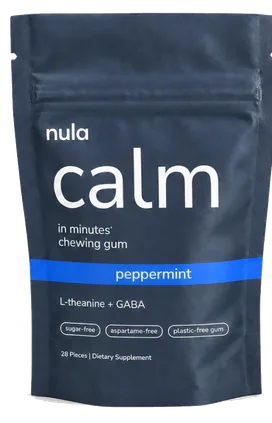
Nula Calm Gum
100 mg L-theanine + 50 mg GABA in every piece. caffeine-free. chew 1–2 pieces for at least three minutes.
shop calm